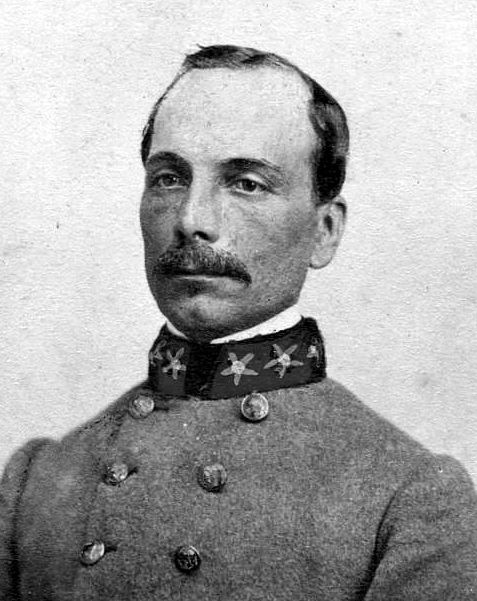
When Spanish bullets tore through Ambrosio José Gonzales’s thigh in a Cuban plaza in 1850, he became immortalized as the first Cuban to shed blood fighting for independence from Spain. 14 years later, he would command Confederate guns against Union troops at the Battle of Honey Hill, inflicting one of the most lopsided defeats of the Civil War.
Born in Matanzas, Cuba on October 3, 1818, Gonzales entered a world of educators and intellectuals. His father worked as a schoolmaster who founded the first daily newspaper in Matanzas. When his mother died during his childhood, his father sent him to Europe and New York City to receive an education in 1828. In New York, young Gonzales formed a friendship with lasting consequences. He became close with Pierre Gustave Toutant Beauregard, a Louisiana Creole boy who would later become a general in the Confederate army. This childhood bond would later provide Gonzales with direct access to Confederate military leadership.
After completing his education, Gonzales returned to Cuba and enrolled at the University of Havana, earning degrees in arts and sciences in 1839, followed by a law degree. He claimed fluency in four languages—English, Italian, and Spanish—and possessed expertise in mathematics and geography. Rather than pursue a lucrative legal career, Gonzales became disillusioned with the corruption of Spain’s colonial judicial system and gave up a lucrative career on principle to become a professor at the University of Havana, where he taught languages.
By 1848, Gonzales had grown thoroughly alienated from Spain’s repressive colonial regime. He joined the Havana Club, a secret organization dedicated to achieving Cuban annexation by the United States. His education, linguistic abilities, and connections made him an ideal advocate for the cause. By 1849, Gonzales became interested in the revolutionary plans of Venezuelan General Narciso López, who led several military expeditions aimed at liberating Cuba. López designed the flag that would eventually become Cuba’s national banner, and Gonzales collaborated with López in its creation, featuring blue and white stripes, a red triangle symbolizing the blood required for liberty, and a solitary white star.
Gonzales rose to become López’s second in command and chief of staff. His first major mission involved traveling throughout the American South to recruit U.S. Army General William Worth to lead an expedition. Gonzales undertook an arduous journey by boat, stagecoach, and horseback but arrived too late. Worth had died unexpectedly.
The most significant attempt came on May 19, 1850, when López and Gonzales led an invasion force that landed at Cardenas, Cuba, aboard the steamer Creole. Armed with old flint muskets and only fifty Mississippi rifles, the expedition captured the governor’s palace after fierce fighting.
As Gonzales walked across a plaza to demand the Lieutenant Governor’s surrender, Spanish forces opened fire. Two bullets struck him in the right thigh. In that instance, he became the first Cuban to bleed in the struggle to expel Spain. Despite initial success, local Cubans failed to rise in support, Spanish reinforcements arrived, and the revolutionaries were forced to evacuate while being chased by the Spanish warship Pizarro.
In 1851, López attempted a final expedition, but Gonzales was sidelined with bilious fever. This illness likely saved his life. López’s expedition ended in disaster, with the general captured and executed by garrote on September 1, 1851. His final words reportedly were “Goodbye, dear Cuba.” The Spanish government sentenced Gonzales to death in absentia, making it impossible for him to return to his homeland.
Realizing that Cuban independence remained distant, Gonzales began establishing roots in his adopted country. He settled in Beaufort, South Carolina, around 1853, and became a firearms dealer. In 1856, Gonzales married Harriet Rutledge Elliott, the 16-year-old daughter of William Elliott, a wealthy South Carolina rice planter. This marriage integrated Gonzales into one of South Carolina’s most aristocratic families. The couple would have six children together. Gonzales’s sense of duty to his adopted state and his wife’s family would motivate his decision to support the Confederacy when South Carolina became the first state to secede in December 1860.
Gonzales served as a volunteer staff officer during the bombardment of Fort Sumter on April 12 through 13, 1861, commanding artillery that fired upon the federal garrison. General Beauregard’s official dispatch praised his staff for their “indefatigable and valuable assistance, night and day, during the attacks on Sumter, transmitting, in open boats, my orders when called upon, with alacrity and cheerfulness, to the different batteries, amidst falling balls and bursting shells.”
Following Fort Sumter, Gonzales submitted comprehensive plans for coastal defense that caught the attention of Confederate military engineers. Major Danville Leadbetter remarked that “The project of auxiliary coast defense herewith, as submitted by Col. A. J. Gonzalez, though not thought to be everywhere applicable, is believed to be of great value.” Gonzales was commissioned as Lieutenant Colonel of artillery and assigned as an inspector of coastal defenses.
Gonzales’s most significant military innovation came in the form of what he termed a “siege train” of flying artillery. This system placed heavy artillery on specially modified carriages that dramatically increased their mobility. Traditional coastal defense relied on fixed fortifications with immobile heavy guns, which Union naval forces could simply avoid. Gonzales’s mobile artillery system allowed Confederate forces to rapidly reposition heavy guns to threatened positions, making it possible to defend long stretches of coastline with limited resources. Union forces could no longer predict where Confederate artillery would be positioned, as the guns could be moved overnight to counter new threats.
In 1862, Gonzales was promoted to Colonel and appointed Chief of Artillery for the Department of South Carolina, Georgia, and Florida, a position he would hold until the war’s end. At Battery Wagner on Morris Island, Gonzales planted land mines in the gorge that helped impede the famous Union assault of July 18, 1863, spearheaded by the African American 54th Massachusetts Regiment.
Gonzales’s finest hour came on November 30, 1864, at the Battle of Honey Hill near Beaufort. Major General John P. Hatch commanded approximately 5,000 Union troops, many African American soldiers, making this the first battle in U.S. history fought primarily by African American soldiers. Against this force, Confederate defenders numbered only 1,200 to 1,400 men, mostly Georgia militia, supported by seven artillery pieces under Gonzales’s command. Major General Gustavus W. Smith reported after the battle that “I have never seen pieces more skillfully employed or more gallantry served upon a difficult field of battle.”
The results spoke to Gonzales’s tactical brilliance. The Union Army suffered over 700 casualties. Confederate losses amounted to roughly 50. This nearly 16 to 1 casualty ratio represented one of the most lopsided Confederate defensive victories of the entire war.
Despite his professional competence and innovative thinking, a personal feud with Confederate President Jefferson Davis resulted in Gonzales being denied promotion to brigadier general six times. Despite this frustration, Gonzales continued to serve faithfully until surrendering at Hillsboro, North Carolina, in April 1865.
The war’s end left Gonzales ruined financially. When he returned to Charleston, his loyal horse represented his only possession. Without fear, Gonzales tried to make ends meet, attempting various businesses that ended in failure. He traveled to New York to work as an interpreter, accepting separation from his beloved family.
In 1869, Gonzales received an offer to return to Cuba to accept a college teaching position. He moved his entire family to Cuba, hopeful for a fresh start. However, tragedy struck swiftly. Shortly after their arrival in October 1869, Harriet contracted yellow fever and died. 25 years later, he would write that “For me, she is not dead, she is in my heart.” Left with six orphaned children and no steady employment, Gonzales eventually returned the children to the United States.
Gonzales left his six children with members of his late wife’s Elliott family in South Carolina. For the next 23 years, he worked various jobs to support and educate his children, eventually finding employment with Hispanic American embassies in Washington, D.C.
Despite hardships, Gonzales succeeded in his most important mission. Three of his sons, Ambrose Elliott, Narciso Gener, and William Elliott, rose to become influential journalists and political activists. By the early 1890s, paralysis had undermined Gonzales’s physical constitution. In September 1893, his sons sent him to Key West, Florida.
Ambrosio José Gonzales died on July 31, 1893, in New York, never having seen his beloved Cuba achieve independence. He was buried at Woodlawn Cemetery in the Bronx. The flag Gonzales helped design in 1849 would eventually fly over an independent Cuba in 1902, vindicating his sacrifice. His sons’ prominence demonstrated how Hispanic heritage integrated into Southern culture across generations. Colonel Gonzales died as he lived, dreaming of freedom, having sacrificed personal fortune for his principles, and having educated children who carried forward his legacy of intellectual courage and public service.
In the end, Gonzales embodied the unlikeliest of Confederate officers, a Cuban revolutionary whose adventurous spirit and idealistic pursuit of liberty carried him from Caribbean battlefields to Southern coastal defenses, forever seeking independence for nations that would remain beyond his grasp.
The views expressed at AbbevilleInstitute.org are not necessarily those of the Abbeville Institute.




There is at least one big editing issue in this article. It states in the last couple of paragraphs that his sons sent him to Key West in September 1893 and then apparently he died in New York in July 1893.