
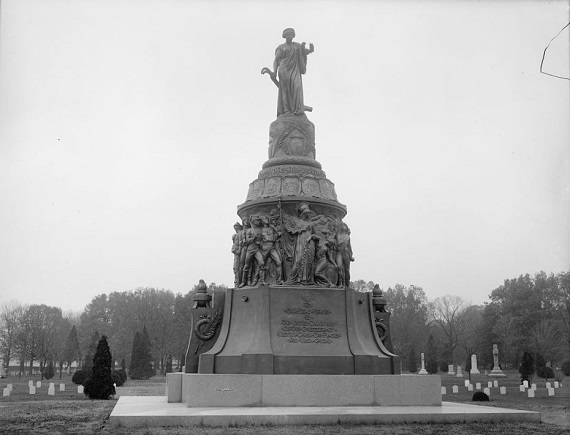
Military pomp and Masonic ceremonies combined to make noteworthy the internment of the late Sir Moses Ezekiel in Arlington National Cemetery on March 30, 1921. The American sculptor, musician and soldier, died in Rome, Italy, in 1917 but the homecoming was deferred on account of World War 1.
Permission was granted by Secretary of War Baker to bury Ezekiel’s mortal remains at the foot of Ezekiels’ work in Section 16.
The ceremony marked the first funeral at the Arlington National Cemetery memorial amphitheater. The ceremony attracted a large throng including the Ezekiel family from Cincinnati.
Eight cadet officers from the Virginia Military Institute where Sir Moses was a cadet during the fratricidal war between North and South, and as such fought at New Market, VA on March 13, 1864, when the cadet corps, acting as reserves, suffered heavy casualties, served as a guard of honor.
After a memorial ceremony the night before, the afternoon funeral and internment services included: Reading of President Harding’s letter by Mrs. Marion Butler, address by Secretary of War John W. Weeks, Tribute entitled “Sir Moses Ezekiel as an Adopted Son of Italy” by Rolandi Ricci, the Italian Ambassador to the United States. Col. Robert E. Lee, grandson of Gen. Robert E. Lee also presented an address entitled “Sir Moses Ezekiel as an American and as a Southerner”.
In his letter, President Harding characterized Ezekiel as “A great Virginian, a great artist, a great American and a great citizen of world fame.”
“Ezekiel will be remembered,” the President wrote, “as one who knew how to translate the glories of his own time and people into that language of art which is common to all peoples and times. He served his state in the conflict that threatened to divide, and that at last served to unify our country. He accepted the verdict of the Civil War’s arbitrament with all that fine generosity that has been characteristic of both the North and South and the splendid product of his art, that here testified to our nation’s reunion, will stand from this day forth as guardian over his ashes, the monument before which you are to-day laying his dust for its eternal rest: a monument simply dedicated by the United Daughters of the Confederacy to “Our dead heroes.”
“Every line and curve and expression carries the plea for a truly united nation that may be equal to the burdens of these exacting times. It speaks to us, the ardent wish, the untiring purpose, to help make our people one people, secure in independence, dedicated to freedom, and ever ready to lend the hand of confident strength in aid of the oppressed and needy.
It is the memorial of reunited America, the testimony to the tradition of insdissolute union, the shrine to which are gathered to-day and will gather through years to come, those who would dedicate themselves to the ideal of unselfish, enlightened upstanding Americanism as a force for our country’s maintenance and all humanity’s betterment. ”
Pallbearers were Edwin A. Alderman, President of the University of Virginia, Congressman Nicholas Longworth of Ohio, for whom the House Office Building on Capitol Hill is named, Culbert Powell Minnigerode, Director of the Corcoran Gallery, Congressman R. Walton Moore of Virginia, Reed Williams, Assistant Secretary of War in the Wilson Administration, and George J. Zolnay, sculptor and President of the Washington Art Club.
Music by the United States Marine Band who played “Love’s Dream” written by Ezekiel’s special friend, Franz List and “The Dying Poet”.
An eloquent tribute to the memory of the distinguished artist was made by Rabbi David Philipson, of Cincinnati, who also made the closing prayer under the watchful eye of VMI Cadets who guarded their brother in arms as Ezekiel had also done as Corporal of the Guard of Thomas J. Stonewall Jackson’s funeral in Lexington.
Washington Centennial Lodge No. 14, F. and A.M. officiated in the Blue Lodge rites and the casket flowers were provided by the Washington Daughters of the Confederacy in memory of the late Colonel Hillary A. Herbert, Chairman of the Executive Committee of the Arlington Confederate Memorial Association.
Newspapers from every state in the union covered the event, many of which placed the event on its front page including the Daily Sentinel in Rome New York.
Upon his burial, the Memorial marking Section 16, became a grave marker also for Moses Ezekiel until it was removed between Hanukkah and Christmas in 2023. It has yet to be restored and remains in storage.


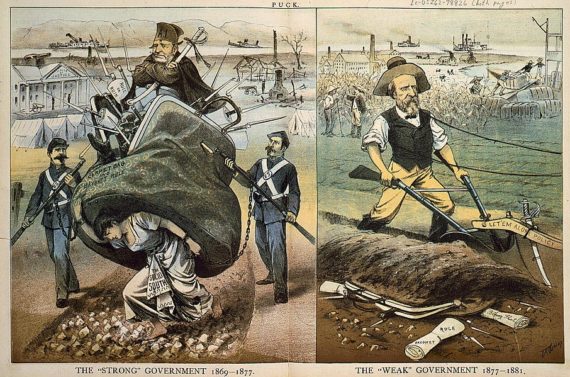


Robert E. Lee, according to clever posers with ostensible admiration for the General, made it his purpose late in life to be sure there would be no Confederate monuments. Indeed, he made an oblique admonition against them; as a modest man, he surely wouldn’t want to see his likeness on a pedestal. Growing up surrounded by Washington iconography, and understanding his place in the late events, he may have expected it.
Moses Ezekiel returned to Virginia Military Institute after the War to finish his education, class of ’66, and became good friends with Washington College President RE Lee and his family. Seeing Moses’ interest and talent in art, General Lee encouraged him to pursue his talents, telling the Confederate veteran, “Try to prove to the world that if we did not succeed in our struggle, we are worthy of success.”
Becoming renowned for numerous classical sculptures of Greek heroes, great artists, and possibly his favorite, Thomas Jefferson of Monticello, Moses surely did show the worthiness of the Confederate cause with the Reconciliation Memorial, VMI’s “Virginia Mourning Her Dead” which keeps vigil over his comrades killed at New Market, and two remarkable life size statues of Stonewall Jackson.
Ezekiel’s greatest disappointment was never having the “chance as a Virginian and an old soldier in a monument to our Hero”, Robert E. Lee. At one point he complained of the commissions for Confederate monuments going to “Northern job hunters.” There are Centennial era reproductions of miniatures from an abortive project for a bust of General Lee that can be found occasionally at collector and antique sites, for a price. Robert E. Lee, Jr. is said to have told Ezekiel it was the best likeness of his father.
After his long eventful life as a world traveller and acclaimed artist, Moses Ezekiel’s epitaph over his grave at Arlington reads simply:
Moses J. Ezekiel
Sergeant of Company C
Battalion of the Cadets
Virginia Military Institute
I did nit know he was a Brother. /G\
Wasn’t aware, myself.
Elephants are giants and bury their dead.
Coyotes creep around at night and dig up and despoil the dead
An ass will kick at a dead lion.