The War Between the States conjures images of Union blue and Confederate gray clashing across rolling farmland and forested ridges. Yet beyond those storied battlefields, another war unfolded in the marble halls and counting houses of Europe. There, empires maneuvered in the shadows, weighing whether to shatter the American experiment forever or stand aside and watch it consume itself.
No European power ever formally recognized the Confederate States of America as a sovereign nation. Every major government declared official neutrality. But beneath this veneer of diplomatic propriety, the reality proved far more intriguing. Several nations recognized the Confederacy as a belligerent, granting it limited rights such as allowing its ships to dock in foreign ports. Britain, France, Spain, the Netherlands, and Brazil all extended this status. The Lincoln administration made its position unmistakable, warning every European capital that formal recognition of the rebellion would constitute a declaration of war against the United States.
Great Britain emerged as the Confederacy’s most consequential foreign partner. The British textile industry, concentrated in Lancashire, depended heavily on Southern cotton. Liverpool, where that cotton arrived for the hungry mills, became the de facto European headquarters of the Confederate cause.
The trading firm Fraser, Trenholm & Co., headquartered at Rumford Place near Liverpool’s docks, served as the Confederacy’s financial agent throughout Europe. Its managing director, Charleston-born Charles Prioleau, coordinated virtually all Confederate naval procurement and financial dealings across Great Britain.
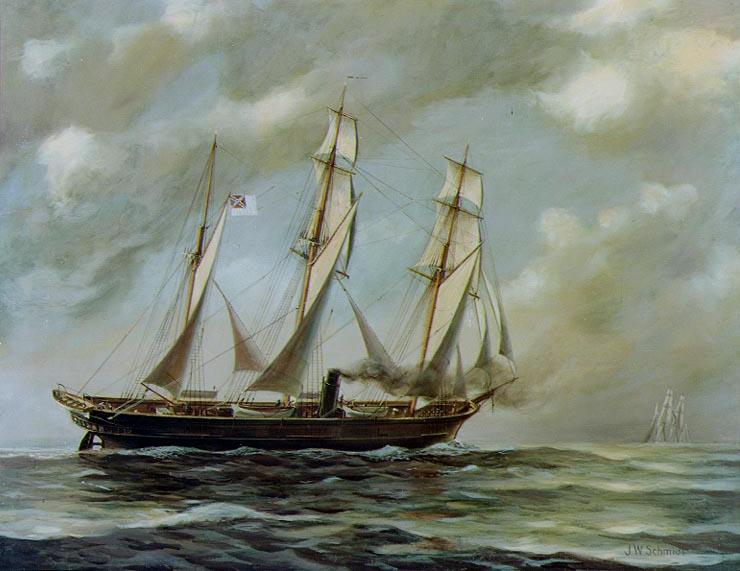
The most explosive example of British assistance involved Confederate warships constructed in British shipyards. The CSS Alabama, built secretly by John Laird Sons & Co. in Birkenhead on the River Mersey, became the most notorious commerce raider of the war. Commanded by Captain Raphael Semmes, the Alabama spent nearly two years capturing and destroying 65 Union merchant ships across expeditions stretching from the Eastern Atlantic to the Java Sea. The man overseeing all Confederate naval procurement in Britain was James Dunwoody Bulloch, a Confederate agent from Savannah who operated out of Liverpool throughout the conflict.
Even more formidable were the Laird Rams, two double-turreted ironclads contracted by Bulloch from the same shipyard. Had they been delivered, they could have shattered the Union blockade. U.S. Ambassador Charles Francis Adams pressured the British government so intensely that he famously warned it would mean war. British authorities seized both ships in October 1863 and purchased them for the Royal Navy.
After the war, the United States pursued the Alabama Claims against Britain. An international tribunal in Geneva in 1872 found Britain liable and ordered it to pay $15.5 million in gold as compensation for damages caused by British-built Confederate raiders, including the Alabama, Florida, and Shenandoah.
British merchants and financiers also built and operated the vast majority of blockade runners. British ships attempted to breach the Union blockade roughly 1,300 times, with over a thousand of those attempts succeeding. According to historians, British blockade runners delivered the Confederacy 60 percent of its weapons, one-third of the lead for its bullets, three-quarters of the ingredients for its powder, and most of the cloth for its uniforms. This assistance may have prolonged the war by two years.
The most dangerous diplomatic crisis erupted in November 1861 when the USS San Jacinto boarded the British mail steamer RMS Trent and seized Confederate envoys James Mason and John Slidell, who were traveling to London and Paris. Britain was outraged. Prime Minister Palmerston called it a “declared and gross insult,” deployed thousands of troops to Canada, and prepared the Royal Navy for potential conflict. Prince Albert intervened to soften Britain’s demands, and Lincoln, recognizing the United States could not fight both the Confederacy and Britain simultaneously, ordered the envoys released in January 1862.
In October 1862, Chancellor of the Exchequer William Gladstone delivered a provocative speech in Newcastle declaring that Confederate leader Jefferson Davis had “made an army,” “made a navy,” and appeared to be “making a nation.” This was widely interpreted as a signal that Britain was moving toward recognition. Gladstone later called this speech the “least excusable” error of his career, a “palpable error of the most grave description.” Intriguingly, his name later appeared on a register of holders of the Confederate Cotton Loan, a claim he vigorously denied.
France, under Emperor Napoleon III, was arguably the most sympathetic major power to the Confederacy. Napoleon saw the Civil War as a golden opportunity to reassert French influence in the Western Hemisphere. In 1862, while America was consumed by war and unable to enforce the Monroe Doctrine, French forces invaded Mexico and installed Archduke Maximilian of Austria as a puppet emperor.
Napoleon’s strategy encompassed controlling Mexico’s silver output, building an Isthmian Canal, checking the rising power of the United States, and creating a broader French sphere of influence across Latin America. He championed the ideology of Pan-Latinism, the idea that Catholic, Romance-language nations of the Americas belonged to a “Latin” civilization that France had a responsibility to protect from Anglo-Saxon encroachment.
The Confederacy tolerated French intervention in Mexico, despite it being a blatant violation of the Monroe Doctrine, hoping to win French recognition in return. After the Civil War ended, the United States moved aggressively to enforce the Doctrine. Secretary of State Seward demanded unconditional French withdrawal. By 1867 the French had abandoned Mexico, and Maximilian was captured and executed by Juárez’s forces.
Spain took direct advantage of the Civil War to annex the Dominican Republic between 1861 and 1865, a move unthinkable had the United States been able to enforce the Monroe Doctrine. The Confederacy offered Spain a defensive alliance and withdrawal of any American claims over Cuba in exchange for recognition. Spain appreciated that a successful rebellion would reduce American expansionism, and Cuba became a crucial transit point for Confederate blockade runners. However, Spain was reluctant to act unilaterally and ultimately never recognized the Confederacy.
In sharp contrast, Russia was the only European great power to offer rhetorical support to the Union, viewing a strong United States as a useful counterweight to the British Empire. In September 1863, Tsar Alexander II dispatched two naval squadrons to American waters. The Atlantic squadron under Rear Admiral Lesovskii arrived in New York, and the Pacific squadron under Rear Admiral Popov anchored in San Francisco. The fleets remained for nearly a year.
While Americans celebrated this as solidarity, the Russian motivation was more calculating. With a rebellion in Poland threatening war with Britain and France, Russia needed its fleets in safe, ice-free ports rather than bottled up in the Baltic or Black Sea. Regardless of motive, the effect was powerful. The Russian admiral in San Francisco issued standing orders to engage any Confederate raider that bombarded the city. The presence of Russian warships sent an unmistakable signal to Britain and France that intervention on behalf of the Confederacy would risk broader confrontation.
The focus on Union versus Confederacy has long dominated how Americans remember the War Between the States, and understandably so. But the conflict was simultaneously a geopolitical tournament in which the great powers of Europe probed, maneuvered, and calculated their own imperial interests against the backdrop of American carnage. Britain nearly intervened twice, France exploited the war to plant a puppet monarch in Mexico, Spain seized a Caribbean nation, and Russia dispatched warships to American ports for reasons entirely its own. The war was never only American.





And Russia has suffered ever since…
“The war was never only American.” …and, therefore, was never only about a single subject.