

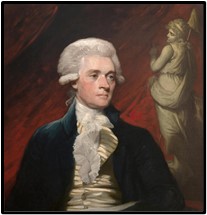
The republicanism that Thomas Jefferson envisaged has never enrooted in America. Over its many decades, it has moved increasingly away from a model of thin, decentralized government, where the states are sovereign—a model at least that Jefferson hoped would slowly emerge, beginning with his two terms as president—to thick, centralized government where the federal government is sovereign and economic measures are instantiated to increase the powers of the federal government at the expense of those of the states.
Jefferson, in his years of retirement, noticed the beginnings of that decline, which he dubbed a neglect of moral law. He elaborates in a letter to Benjamin Rush (22 Sept. 1809):
the interest I have taken in the success of the experiment, whether a government can be contrived which shall secure man in his rightful liberties & acquirements, has engaged a longer portion of my life than I had ever proposed: & certainly the experiment could never have fallen into more inauspicious times, when nations have openly renounced all the obligations of morality, and shamelessly assumed the character of robbers & pyrates. … if it can pass safely through the ordeal of the present trial, we may hope we have set an example which will not be without consequences favorable to human happiness.
Jefferson writes of enduring the harsh times and then hoping that the “pendulum will vibrate the more strongly in the opposite direction,” so “nations will return to the reestablishment of moral law with an enthusiasm which shall more solidly confirm it’s future empire.”
Though he retired from politics, Jefferson began work on the University of Virginia to help make it, in the words of James Madison, a “nursery of Republican patriots.”[1] He wished to birth an institution of higher education that would ready young Virginians, and young Southerners, to lead Virginia and the youthful nation and return it to the principles that led to its revolution: government by the vox populi.
Nothing of the sort occurred in Jefferson’s time, not even in the United States, and nothing of the sort has occurred anywhere up to now. For that, Jefferson is often castigated by scholars for being Micawberish.
Forrest McDonald in The Presidency of Thomas Jefferson says Jefferson’s political vision was oversimple. Moreover, his political philosophy—with its eschewal of bribery, patronage, corruption and coercion—had this flaw: It could be instantiated “only with a Thomas Jefferson at the helm.” Thus, his legacy to Madison proved to be a “can of serpents,” no mere can of worms. McDonald continues: “When Jefferson left the office, all the shortcomings of his method of administration became manifest. The cabinet became a center of petty bickering and continuous cabalizing, and Congress split into irreconcilable factions and repeated asserted its will against the president.”
In “Jeffersonianism and the New Deal,” Morton Frisch asserts that Jeffersonian republicanism was a failed policy, because the political philosophy was unduly atomistic. “The essential failure of Jeffersonian liberalism as it projected itself through the nineteenth century and into the twentieth consisted in a one-sided and oversimplified concentration on individualism and all that this implies for politics and government.” Twentieth-century liberalism, he adds, found a place for governmental regulation—that of ensuring economic wellbeing for citizens through some control of private enterprise and granting some minimum measure of a standard of living.
Drew McCoy, in The Elusive Republic, maintains that the Jeffersonian vision of “peaceable coercion” through employ of his embargo failed due to internal inconsistencies of Jefferson’s economic policies. Jefferson’s policy of extensive agrarianism was predicated on Europeans’ inability to farm for themselves or to import farmed goods from other countries, on American farmers capitalizing on that need, and on Americans not needed exported British luxuries. “Foreigners [thought Jefferson], especially the British, would suffer much more than Americans in any test of commercial strength, since Americans would temporarily be deprived only of markets for their agricultural surplus, while foreigners would ‘feel the want of necessities.’” Yet that policy made Americans’ economy dependent on foreign markets. Thus, the aim of self-sufficiency could not be met, and so, unfair and coercive British policies of trade with the United States eventually led to war during Madison’s presidency in 1812.
In The Paris Years of Thomas Jefferson, William Howard Adams says that Jefferson’s political vision was inconsistent. “A humane society that would somehow reconcile the needs of an active, industrious, virtuous people with a simple yet satisfying agricultural order was a fleeting, abstract goal.” He continues, “By its very structure, the republic of isolated yeomen farmers that he was promoting on the frontiers of America made it impossible to form the critical intellectual and creative mass that a prosperous, progressive society ultimately required.”
Walter LaFeber states in “Jefferson and American Foreign Policy” that Jefferson’s “early belief in the virtues of, and need for, agrarian expansionism” is what led to actions inconsistent with Jeffersonian republicanism—e.g., military action and a strong presidency—in order to protect agrarian and national interests. “His faith in the virtues of agrarian expansion led Jefferson through a series of events that ironically ended in the acceptance of war and manufactures, a call for an entangling alliance, an apology for slavery during the Missouri compromise debates, and deep personal frustration and bitterness in the last fifteen years of his life.”
Norman Risjord, in Jefferson’s America, claims that difficulties in conducting the War of 1812 exposed weaknesses in Jefferson-styled libertarian republicanism. “The humiliations suffered at the hands of the European belligerents showed the weakness of the old Republican doctrines of unobtrusive, frugal government, and the difficulties that the government experienced in fighting the war only confirmed it. … Thus the war exposed the need for more energetic government.”
I shall not address those animadversions, each in its peculiarity, seriatim. I have done that elsewhere. Yet all such arguments, in effect, castigate Jefferson for lack of prescience. He did not see that things were moving in a political direction, a Hamiltonian direction, contrary to his. Many say bluntly: Hamilton was right and Jefferson was wrong. That, however, is a failure of normativity, for Jefferson’s argument was normative: This should be the case because it ought to be the case.
Yet one person—a political activist (not all political activists are bad persons!) and not a scholar—strongly disagrees with today’s scholars. Daniel Miller, president of the Texas Nationalist Movement, has been for some three decades pushing for Texas’ secession from the US. His argument he gives succinctly and counterfactually.
Would the people of any would-be state, knowing what we know today of the ponderous abuses of the federal government at the expense of the individual states, vote to enter the confederation of states?
Miller’s answer? “Absolutely not!”
As Jefferson noted, the rationale for forming the union was to build a coalition of states with unity of purpose only in certain circumstances: e.g., threat of war. Outside of those singular circumstances, for Jefferson, the individual states were always to be sovereign, not the federal government. Yet the states, at least since the time of Lincoln, have lost their sovereignty. The only sensible alternative for Texicans as well as those of any other state is secession.
Enjoy the interview with Daniel Miller below….
[1] James Madison to Samuel H. Smith, 4 Nov. 1826. His concern was the “emigration” of young, talented Virginians to universities in the North and their uptake of Federalist thinking.
The views expressed at AbbevilleInstitute.org are not necessarily those of the Abbeville Institute.




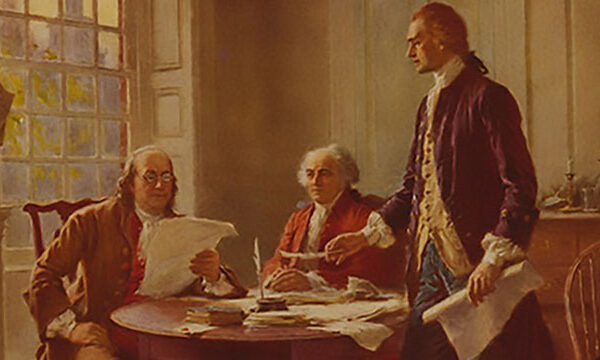


Those “animadversions” have largely a “Monday-morning quarterbacking” and Presentist quality.
What if those writing the Constitution had hewed closer to Jefferson with a 2/3 majority required to declare war (as so many “Anti-Federalist urged)? Jefferson’s embargo mistake would not have led to that stupid war of choice, which like all wars contributed to the health of big government. (It led to the 1st intervention by the Federal govt into banking, shielding bankrupt banks from bankruptcy–a horrible precedent of fascistic dishonesty.)
One cannot blame Jefferson for not foreseeing that the great American experiment would run up against the inherent corruptness of government over time. It really would have been good had he responded to the British affronts by saying “this is wrong, but it is a wrong we cannot correct without doing much more harm to our own people; time is on our side if we do not respond at all except to exclude British ships from our ports.”
It would be great if all counties here in Illinois could separate from Cook Country, if only for one reason, so we never again have to look at or listen to JB Pritzker or anyone like him ever again
People throughout rural Illinois are genuinely happy People. Whereever “progessivism” holds sway, or tries to not so happy. Its quite observable and concrete and reason enough to want to get out