

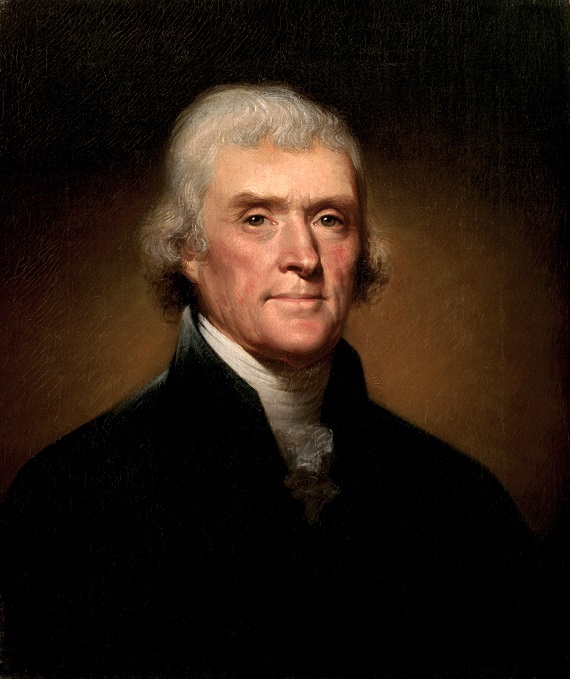
Thomas Jefferson, it is commonly known, was a staunch advocate of religious freedom. He argues for that in detailed notes on religion, his critical comments on the religions of Virginia in Query XVII of Notes on the State of Virginia, and in his Bill for Religious Freedom, drafted in 1776 and passed years later while he was in Paris, inter alia. Jefferson also argues for religious freedom in a letter, in his first term as president, to the Danbury Baptist Association, a group of 23 western Connecticut and three eastern New York Baptist churches. On October 7, 1801, members of the association—Nehemiah Dodge, Ephram Robbins, and Stephen S. Nelson—drafted a letter to newly elected president, Thomas Jefferson. The letter I present in full.
Our Sentiments are uniformly on the side of Religious Liberty—That Religion is at all times and places a matter between God and individuals—That no man ought to suffer in name, person, or effects on account of his religious Opinions—That the legitimate Power of civil government extends no further than to punish the man who works ill to his neighbor: But Sir our constitution of government is not specific. Our ancient charter together with the Laws made coincident therewith, were adopted on the Basis of our government, at the time of our revolution; and such had been our Laws & usages, and such still are; that Religion is considered as the first object of Legislation; and therefore what religious privileges we enjoy (as a minor part of the State) we enjoy as favors granted, and not as inalienable rights: and these favors we receive at the expense of such degrading acknowledgements, as are inconsistent with the rights of freemen. It is not to be wondered at therefore; if those, who seek after power & gain under the pretense of government & Religion should reproach their fellow men—should reproach their chief Magistrate, as an enemy of religion Law & good order because he will not, dare not assume the prerogatives of Jehovah and make Laws to govern the Kingdom of Christ.
Sir, we are sensible that the President of the United States, is not the national legislator, and also sensible that the national government cannot destroy the Laws of each State; but our hopes are strong that the sentiments of our beloved President, which have had such genial affect already, like the radiant beams of the Sun, will shine and prevail through all these States and all the world till Hierarchy and Tyranny be destroyed from the Earth. Sir, when we reflect on your past services, and see a glow of philanthropy and good will shining forth in a course of more than thirty years we have reason to believe that America’s God has raised you up to fill the chair of State out of that good will which he bears to the Millions which you preside over. May God strengthen you for the arduous task which providence & the voice of the people have cald [sic] you to sustain and support you in your Administration against all the predetermined opposition of those who wish to rise to wealth & importance on the poverty and subjection of the people.
The letter is drafted in recognition that each state is responsible for the condition of religious affairs in it—“the national government cannot destroy the Laws of each State,” a sentiment Jefferson iterates in his Second Inaugural Address—but there is nonetheless an appeal to Jefferson by the Danbury Baptists, if only to reply with words of encouragement to sanction their cause. “Our hopes are strong that the sentiments of our beloved President … will shine and prevail through all these States and all the world till Hierarchy and Tyranny be destroyed from the Earth.”
On January 1, 1802, Jefferson drafts a brief reply to the concerns of the Danbury Baptists—a coruscant testimony of the power of words. The letter contains his now-famous wall-of-separation metaphor—the subject of considerable debate in the secondary literature today. Acknowledging receipt of the letter of the Baptists, Jefferson writes of his duty as president to recognize and represent the interest of the citizenry.
My duties dictate a faithful and zealous pursuit of the interests of my constituents, & in proportion as they are persuaded of my fidelity to those duties, the discharge of them becomes more and more pleasing.
He then proceeds to a brief, yet eloquent, expression of the freedom of religious practice, which introduces the famous metaphor of a wall of separation.
Believing with you that religion is a matter which lies solely between Man & his God, that he owes account to none other for his faith or his worship, that the legitimate powers of government reach actions only, & not opinions, I contemplate with sovereign reverence that act of the whole American people which declared that their legislature should “make no law respecting an establishment of religion, or prohibiting the free exercise thereof,” thus building a wall of separation between Church & State.
What was Jefferson’s intention in this carefully crafted letter, sent to members of his cabinet for suggestions, prior to being sent?
Scholar James Hutson argues that Jefferson’s primary intention was political. The FBI’s reconstruction of Jefferson’s original letter—some seven of 25 lines were circled for possible deletion and many words were inked out after getting cautionary advice from Attorney General Levi Lincoln—shows Jefferson’s “principal reason for writing the Danbury Baptist letter” to be a chance to say, in Jefferson’s own words in his letter to Lincoln (1 Jan. 1802), “why I do not proclaim fastings & thanksgivings” as did Washington and Adams. The occasion was the Treaty of Amiens (25 Mar. 1802), which put an end, at least temporarily, to the hostilities between France and Britain, and thereby relieved the United States at that time of potential involvement with one of the nations against the other. Jefferson knew that Federalists, as a result of the treaty, would ask him for a day of thanksgiving, which would likely be pronounced “unconstitutional” by Jefferson, thereby proving his godlessness. By smartly drafting his reply to the Danbury Baptists, Hutson says, Jefferson could “strike back, using the most serviceable weapon at hand,” deliver “a partisan counterpunch, aimed by Jefferson below the belt,” and “mount a political counterattack against his Federalist enemies”—thereby proving false his infidelity and showing himself to be a “friend of religion.”
Hutson’s thesis has been roundly refuted by Isaac Kramnick and R. Laurence Moore. Hutson’s argument, they say, is strange because it is based solely on what Jefferson ultimately decided to omit. “No effort is ever made to indicate how that deletion/omission in any way affects the meaning or purpose of what Jefferson left in.” They continue, “We are asked to understand and evaluate a document by what is left out and ignore what is left in.” To their sockdolager, I merely add that two remarks of my own. First, were Jefferson’s principal reason for writing the letter to be a “political counterattack against his Federalist enemies,” then it is strange that he would soften the draft, as he writes in keeping with Levi Lincoln’s advice in one of the marginalia, to placate “republican friends in the eastern states,” where thanksgivings are customary. Second, an attempt to parry or avoid perceived Federalists’ animadversions is nowise a “political counterattack,” a strike with a “serviceable weapon,” or even a “partisan counterpunch.”
Let us now turn to what Jefferson left in the letter. There is and continues to be considerable scholarly disagreement on such content.
Jefferson’s phrase, “the whole American people which declared that their legislature should ‘make no law respecting an establishment of religion, or prohibiting the free exercise thereof,’” suggests to some that Jefferson’s intendment was prohibition of government’s intervention in matters of church. Derek Davis writes: “A fair examination of Thomas Jefferson’s 1802 letter to the Danbury Baptist Association clearly shows that Jefferson understood the religion clauses to militate against religious institutions being government’s guiding force or the beneficiaries of government benefits. His ‘wall of separation between church and state’ would be a permanent barrier to such practices.” Consistent with abolition of entails and primogeniture and his Bill for Religious Freedom, Jefferson was attempting once again to redress the issue of an artificial aristocracy—the centuries-old notion that Jefferson articulates in a letter to John Adams (28 Oct. 1813) that birth or wealth qualify one for public office. Nonetheless, he argues that the wall of separation is not unidirectional. It is meant to prohibit religious encroachment in political affairs as well as political encroachment in each person’s religiosity.
That too is the view of R. Freeman Butts. “The clause ‘establishment of religion’ included all the desires to prohibit a single established church, but it also applied to plural support to many or all religions…. It prohibited any financial support, directly through tax funds, or indirectly through land for any one or more churches, or for religion in general He sums: “A careful study of Jefferson’s entire career and his views on education from 1779 to 1825 will show that Jefferson was one of the earliest advocates of a public education divorced from all sectarian religious influences. He saw clearly that the principle of separation of church and state for which he worked so long must mean a secular educational system.” In consequence, Jefferson’s notion of separation of church and state was thorough and complete, and his views on education, qua secular practice, were rooted in his thinking on religious freedom.
J.M. O’Neill argues otherwise. He maintains that Jefferson’s views of religion were always friendly. If we follow the pattern of Jefferson’s life, we find a commitment to three fundamental principles: democratic governing, freedom of and equality in religion, and a states’-rights approach to decisions on religion and education. “Jefferson’s total record is consistent proof. In fact he never did or said anything at any time to indicate that he thought the states could not do whatever they thought wise in regard to government provision of religion or religious education so long as they treated all religions alike and preserved religious freedom.”
Robert Cord is in fundamental agreement. Appealing to several of Jefferson’s actions as politician as well as Bills 84 and 85 of the Revisal of the Laws of Virginia (which he assumes were in the hand of Jefferson), Cord argues that Jefferson was not averse at times to using sectarian institutions for secular ends, so long as in doing so he was not privileging any one religion to the detriment of others. Thus, the “wall of separation” metaphor employed by Jefferson in the Danbury-Baptist letter is “nonabsolutist”: Particular religions can never use government to advance their aims, while government can sometimes use particular religions to advance secular aims.
Anson Phelps Stokes goes further. He argues that religious instruction was needed for democracy to thrive. Jefferson, himself a devout religionist, argued for separation of church and state for the sake of the state—that is, a healthy nation. Concerning Jefferson’s University of Virginia, he writes, “even in the establishing a quasi-state university on broad lines, the greatest liberal who took part in founding our government felt that instruction in the fundamental of Christian theism and Christian worship were both important and proper.”
Daniel Dreisbach, in keeping with Cord’s thesis, argues that Jefferson’s Bill 82 should not be taken independently of the four other companion bills—Bills 83 through 86, of which “Jefferson was the chief architect, if not the actual draftsman,” even though “a couple of them were revisions of provisions that had long been on the statute books of Virginia.” Those bills allow for “limited state cooperation with religious institutions … if it advanced freedom of religious belief and expression” or if they advanced “the legitimate secular goals of the civil state.” The wall-of-separation metaphor, then, was meant to apply strictly to the federal government and religious institutions or practices.
Johann Neem says Jefferson had in mind something more fundamental than a wall that protected church from state or state from church. Its implications went beyond political and religious concerns. Jefferson’s intendment was free inquiry. “The wall of separation was not intended to banish religion from the public sphere of civil society. Instead, it was intended to prohibit an alliance between ministers and politicians that would limit free inquiry. Free inquiry would allow persons to question centuries of fabricated mysticism invented by ministers.”
What are we to conclude?
Davis is correct to note freedom of religion was both for freedom from governmental intrusion in citizens’ personal affairs—viz., matters of conscience—and for freedom from religious intrusion in governmental affairs, which historically have been contaminated by religious prelates. Moreover, the conclusions of Cord and Dreisbach must not be given short shrift, if it is the case that Jefferson fully endorsed the proposals of Bills 83 through 86. Finally, Stokes’ view, with some modification, is relevant.
However, I shall follow up on the suggestion of Neem that Jefferson’s real intent in setting up a wall of separation between church and state was free inquiry. That claim has, I believe, much in its favor. Yet Neem does not go far enough, for free inquiry for Jefferson was not an end, but a means. As always, Jefferson’s true aim was continued human advance—i.e., human thriving or happiness. For that to happen, the natural, not the artificial, aristocrats had to be governing, and the natural aristocrats for Jefferson comprised those persons preeminent in genius and virtue. Religiosity was irrelevant. Thus, there needed to be a wall of separation between church and state so that political affairs, at least at the federal level, were not decided by religious partialities of sectarian religions. Thus, the wall was meant to work both ways: to prohibit religious intrusion in governmental matters, especially at the federal level, and to prohibit governmental intrusion in religious matters. Yet as the passage in his Notes on the State of Virginia about silencing religious disputes by ignoring them implies, Jefferson’s real aim was preventing religious intrusion in political matters—religious empleomania. The prohibition against governmental intrusion in religious practices was, in some sense, throwing a bone to a dog. He wished to concede something to religious clerics and willingly did so because he recognized that that concession, given prohibition of religious intrusion in governmental affairs, would be effete. Rigorous debate on whether God is three or one or on whether Jesus could walk on water would be just so much ignis fatuus.
The views expressed at AbbevilleInstitute.org are not necessarily those of the Abbeville Institute.





I’m sure it’s worth next to nothing, coming from common blood with Jefferson.
And praying I’m wrong
Center cut bullseye Dr. Holowchak, suh
Thank you.