

This post was originally published at ChroniclesMagazine.org.
A review of A Hell of a Storm: The Battle for Kansas, the End of Compromise, and the Coming of the Civil War (Scribner, 2024) by David S. Brown
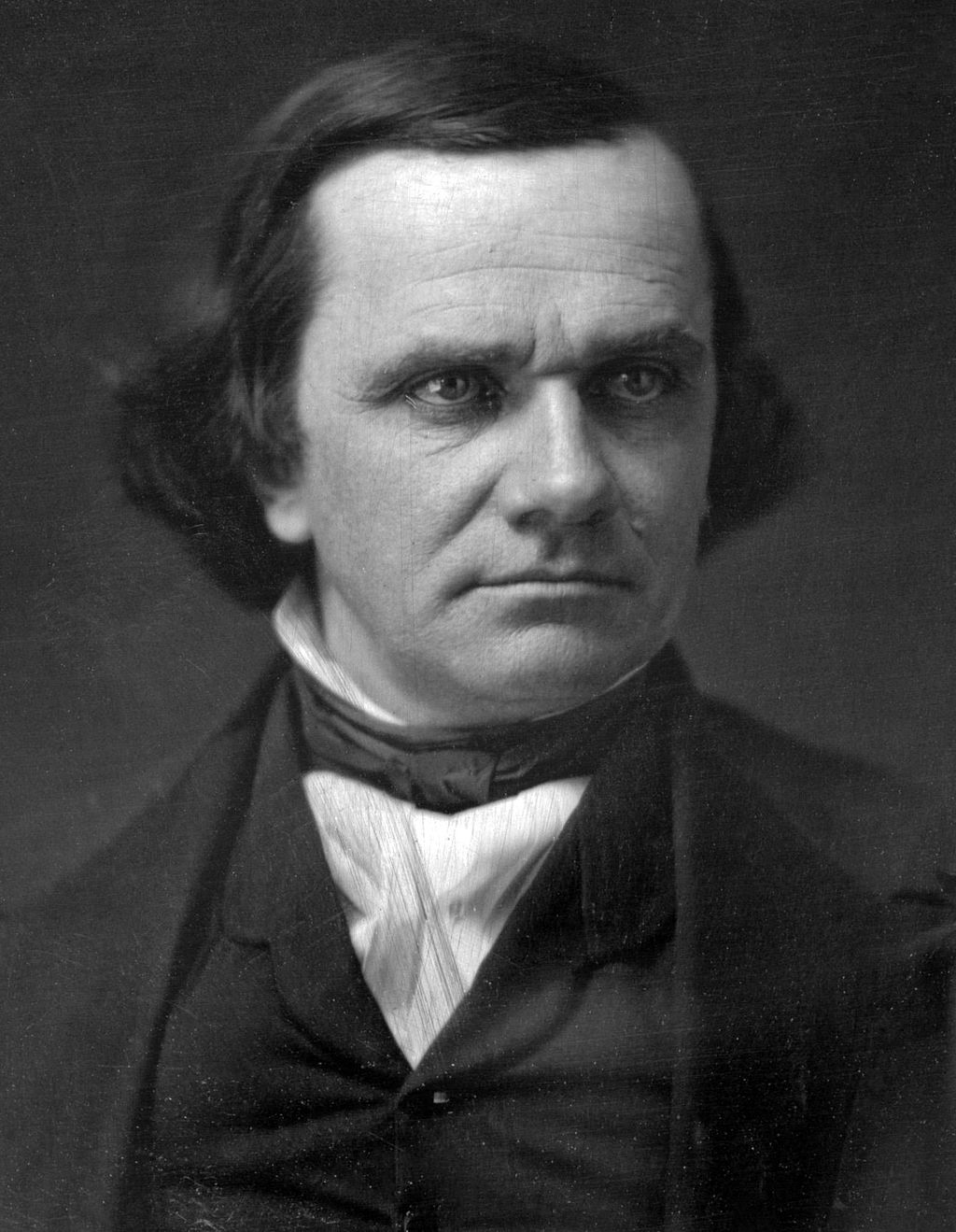
The key to understanding the U.S. Civil War is the Kansas-Nebraska Act of 1854, which allowed individual U.S. states to decide on the legality of slavery based on a popular vote. Senator Stephen Douglas (D.-Ill.) proposed the act in order to get Southern lawmakers’ support for a transcontinental railroad project that would unite the country—and that, crucially, would end in Chicago, the largest city in Douglas’s state. But the result of the senator’s ambition was not to unite the country, but to tear it apart.
This is the story Elizabethtown College History Professor David S. Brown tells in A Hell of a Storm. Brown contends that controversy over slavery between the North and the South was controlled until the early 1850s, when Douglas sought to organize the Platte River country (also known as Nebraska) into a territory, for the purpose of building the transcontinental railroad. Douglas underestimated the potential to “shatter the unstable sectional peace” achieved by the Compromise of 1850 and Missouri Compromise, Brown writes, which had generally confined slavery to the South. From Douglas’s introduction of the Nebraska bill onward, Brown asserts, the issue of slavery in the territories became the central issue in American politics—one that the old system of compromise could not contain.
Why would Douglas risk upheaval in the Union? Partly because of his personal ambition; the senator, known as the “Little Giant” due to his small stature and forceful personality, had eyes on the presidency. As an Illinois politician, he was convinced of the importance of connecting Chicago with the Pacific via railroad. Douglas saw the railroad as promoting national economic growth and thus lessening sectionalism, Brown writes. He also notes that Douglas believed he would rule Illinois politics if he could boast of making Chicago the eastern terminus of the railroad.
Brown does not fully give Douglas’s obsession to tilt the scales in favor of his state and its largest city the emphasis it deserves. There already existed logical termination points for the railroad in Southern cities, including St. Louis, Memphis, and New Orleans, and a route with those cities wouldn’t have required organizing new territories and risking political disruption over the question of slavery in those territories.
As historian Clarence B. Carson has observed, congressional surveys indicated that “the best route in terms of terrain, and the fewest physical obstacles to overcome, would be a southern route.” There were settlements along a southern route, and it traversed no unorganized territory. In other words, a southern route made the most sense.
The Kansas-Nebraska Act is often portrayed as a Southern conspiracy to spread slavery. Instead, Brown convincingly argues that it was a product of Douglas’s desire to promote his career and to advance the fortunes of Illinois. Had Douglas and his Illinois political machine accepted that, say, Memphis was the logical terminus for the railroad, the sectional strife that led to the Civil War could have been avoided.
Before the chaos that Douglas created, a peace over the issue of slavery had been achieved by Senator Henry Clay’s Compromise of 1850, which Douglas had shepherded through Congress as multiple bills. The Compromise settled the question of the legality of slavery in the territories acquired by the U.S. during the Mexican-American War. Clay’s bill admitted California as a free state; paid Texas for giving up claims to territory in New Mexico; permitted the residents of the region that now encompasses the states of New Mexico, Arizona, and Utah to decide the slavery issue based on popular sovereignty (a popular vote within the state); established a stricter Fugitive Slave Act that required citizens of free states to cooperate with the capture of escaped slaves; and abolished the slave trade in the District of Columbia. Both North and South believed that they gained important points in these compromise measures.
Douglas mistakenly concluded that the popular sovereignty piece of the Compromise could be applied to the territories of Kansas and Nebraska, which had to be organized if he hoped to secure the railroad for Chicago. He also believed that the abrogation of the Missouri Compromise (both Kansas and Nebraska lay north of the 36° 30° latitude line that the Missouri Compromise used to separate Northern free states from Southern slave states) would raise no issues. The measure passed the Senate with little trouble but barely squeaked by in the House of Representatives.
After discussing the passage of the Kansas-Nebraska Act, Brown’s book delves into the coalescing of Northern public opinion, especially as shaped by Harriet Beecher Stowe, William Lloyd Garrison, John Brown, Harriet Tubman, Abraham Lincoln, and the writings of Ralph Waldo Emerson and Henry David Thoreau.
As for the Southern perspective on the sectional divide, Brown is virtually silent. He does offer a discussion of a band of adventurers trying to invade Mexico’s Sonora, which he uses to represent the Southern greed for more slave territory. And while Brown recounts sermons from Northern theologians against slavery, he provides nothing from the likes of Southern theologian R. L. Dabney, who wrote about the biblical case for slavery. Brown transcribes speeches against the Kansas-Nebraska Act in detail, but the Southern arguments for access to the common territories are missing from his book. Brown studies Northern contentions that the Framers caused the South to be overrepresented in the nation’s councils, but does not acknowledge Southern concerns that the growth of the Northern population would soon require submission to Northern policy demands.
The only Southern figure Brown gives detailed attention to is the Virginia theorist George Fitzhugh and his book Sociology for the South (1854), which argued, among other things, that slavery was a positive good and a more humane system than that of the industrializing North.Brown describes the pro-slavery Fitzhugh as a “whisperer of moonlight and magnolia mythology” offering “warmed-over complaints” of Northern “workshop culture” and a defense of scientific racism. Interestingly, Brown later makes a similar critique of Northern factory life, describing Irish immigrants to Boston as “exploited in depressing sweatshops and pinched uncomfortably in blighted North End neighborhoods.”
In short, the book is one-sided. It is akin to a foreign policy scholar writing a paper on the Russo-Ukrainian War that only considers the Ukrainian and Western perspectives. While Russian President Vladimir Putin is unpopular in the West, an account of the war ignoring the Russian objections to NATO expansion and the historical ties between Russia and Ukraine would be, at best, incomplete.
The reader is consequently left in the dark about sundry issues. For example, Brown lambasts the popular sovereignty of the Kansas-Nebraska Act as violating the sanctity of the Missouri Compromise. He hardly acknowledges that with the Compromise of 1850 and accepting the entirety of California as a free state, the North itself rejected the Missouri Compromise. Had the Missouri Compromise’s 36° 30° latitude line been extended to the Pacific Ocean, much of California would have been open to slavery. Thus, it was not Southerners whispering in Douglas’s ear who scuttled the Missouri Compromise, but Northerners eager for the admission of a state that would support their interests.
Brown also ridicules Douglas for “winking to Northerners that an uncooperative climate made cotton cultivation an impossible proposition for the plains.” In other words, Douglas was implying that his concession to Southerners to extend slavery to new territories was a meaningless concession, because the acquired lands were not conducive to the Southern plantation system. Going into the 1860 election, most Americans did not believe that the extension of slavery was the central issue, as historian Michael Holt chronicled in The Election of 1860: A Campaign Fraught with Consequences. A number of Southern Democrats, however, did. But many of these, Holt explains, “admitted that the question was an abstraction with no practical significance with regard to the existing land area of the United States.”
If most of the country agreed with the premise behind Douglas’ “winking,” then why did sectional tempers rise to the boiling point? Brown seems oblivious to the effect of abolitionist rhetoric on Southerners. But for John Brown’s raid on Harpers Ferry and the unhinged rhetoric of the abolitionists, Southern Democrats likely would have held their noses and supported the Democratic Party candidate, Douglas, rather than let the Republicans put Abraham Lincoln in the White House.
While there is nothing wrong with a book favorable to the Northern abolitionist movement, the author should have admitted his purpose from the beginning. Unfortunately, Brown presents A Hell of a Storm as an objective history of the Kansas-Nebraska Act and the factors that led to the Civil War. It is rather the work of a court historian who presents the viewpoint of the winning side, hides the Southern perspective, and cartoonishly portrays the disputants as Good Men vs. Evil Men. The truth, of course, is much more complicated.
The views expressed at AbbevilleInstitute.org are not necessarily those of the Abbeville Institute.



The northern transcontinental railroad act awarded the land equivalent of the State of Texas to railroads, in addition to a guaranteed profit per mile of track laid. Douglas worked for the railroads, lincolon worked for the railroads, General McClellan worked for the railroads. Even General Nathan Bedford Forrest was a railroad man after the war.
Wars are always fought over money. After 4 July, 1776, the north sold slaves to the South, prior to that date, the King of England benefitted from these sales…the north built the entirety of slave ship fleets, financed by northern and European banks…the north collected good money for these ventures, then wanted to keep the South as a colony paying the bills of fedgov. European countries levied tariffs paid by Southern exports of cotton and tobacco to retaliate for northern tariffs on European finished goods. Ultimately, the north wanted to free the slaves, steal $4Billion in assets from the South and continue to pay the South below-market wages for its products. This is how colonies are used by sovereigns. Four Billion dollars in 1860 was the GDP of these united States…in today’s money, that’s 30 TRILLION dollars the north stole from the South.
Slaves were only seen as 3/5ths of a human by NORTHERN interests…it is always about the headcount in a DEMOCRACY…which is why our Founding Fathers did not give us a DEMOCRACY.
The $4Billion arrived at by the 4 million slaves at 1000 dollars per slave. The northern congress bought house servants from themselves in April 1862 for 300 dollars per head…house servants are a drag that doesn’t add to the bottom line…field hands were much more valuable than house staff.
Clay’s bill admitted California as a free state; paid Texas for giving up claims to territory in New Mexico;…wonder why Texas accepted that and then chose to fight for the CSA
After discussing the passage of the Kansas-Nebraska Act, Brown’s book delves into the coalescing of Northern public opinion, especially as shaped by Harriet Beecher Stowe, William Lloyd Garrison, John Brown, Harriet Tubman, Abraham Lincoln, and the writings of Ralph Waldo Emerson and Henry David Thoreau…..worse than MAD magazine for the period?