Originally published at A Memoir of the Occupation
Richmond, Virginia April 15, 1985
It was raining again. Grey clouds scudding the city’s ruins standing in stark silhouette against the colorless sky. Jagged shards of warehouse riding from the ruined James River waterfront; the business and residential districts block after block of fire-blackened brick, the Tredegar Iron Works no more than a shell. The Capitol, designed by Jefferson in the style of a Roman temple, was itself undamaged. But when the wind whipped the limp flag on the pediment, it unfurled to reveal the Stars and Stripes, the banner of the Occupier.
But people still dwelt there, and in the morning they emerged from their shelters and gathered on the redbrick sidewalks of Main Street. They had waited his arrival since April 12, when he departed Appomattox Court House, even placing a watch at the pontoon bridges to give notice of his return.
Then they saw him: a broadshouldered man on a grey horse, winding his way through the rubble-choked streets. A man with a white beard and dark eyes and sat erect on his saddle in the worn uniform of a general of the army of the Confederate States. Two aides followed on gaunt horses. Several battered wagons ended the train, “U.S.” was stenciled on the side of each.
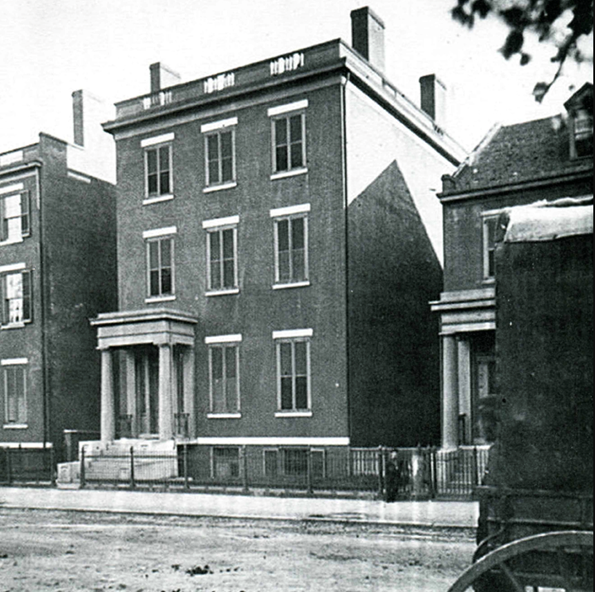
It was Robert E. Lee, once the commanding general of the Army of Northern Virginia. He was home: 707 East Franklin Street, a townhouse loaned by a Richmond industrialist. Arlington, his ancestral home, was now the property of the United States.
Six days ago, clad in his finest uniform, he met a muddy little man in the parlor of a house in Appomattox Court House. There he had surrendered his army: the less than thirty thousand who remained of the magnificent Army of Northern Virginia: starving, ragged, without rations and barely ammunition, surrounded by the 140,000 well-fed troops under the muddy little man’s command.
There was much rejoicing in the camps of the conqueror on April 1, 1865, when the Army of the Potomac achieved a rare indisputable triumph against the Army of Northern Virginia. We wrote about it here.
In short, a 22,000-strong swarm of Union cavalry and infantry overwhelmed a Confederate force half that size defending the strategic junction of Five Forks at the western extremity of the Petersburg defenses.
Grant, the muddy little man, had established headquarters at Dabney’s Mill on the Petersburg front. When the courier galloped to the campfires where the Union commanders warmed themselves, some were skeptical. It was, after all, April Fool’s Day. Grant sent Colonel Horace Porter, his secretary, to investigate.
Porter mounted his Bucephelas and rose west. The roads were a horror: churned to a gelatinous muck by the passage of armies, lined with dead horses and broken wagons, canteens and packs and the general detritus of war. Soon, though, Porter came upon the alleged victors: muddy, exhausted infantrymen from Warren’s V Corps. Yes sir, the men said wearily, eyeing the well-scrubbed gold-braided officer with suspicion. Still, they dutifully confirmed an astounding victory and had 3,000 Secesh prisoners to prove it. “Everyone was riotous over the victory,” Porter said.
He galloped back to Dabney’s Mill. His aides bellowed tidings of the triumph. Reports suggest many Billy Yanks, mired before Petersburg for the last nine months, weren’t buying it. “April Fools!” One old soldier snorted. They had heard these promises before.
But Grant’s staff believed. They shook hands, shouted with joy, hugged like schoolboys. Porter himself beat a manly tattoo on the back of an initially dumbfounded Grant. One officer would describe Five Forks as a battle “admirable in conception, brilliant in execution, strikingly dramatic in its incidents and productive of immensely important results.” A veritable Austerlitz! Well, not exactly, but still Grant’s army was now within reach of the Southside Railroad, the last Confederate line into the city, and the isolation of the Southern army.
Grant went into his tent and lit a candle. He scribbled in his order book, tore out the pages and handed them to an orderly, who trotted to the telegrapher for dispatch to points near and far. Grant rejoined his joyful officers around the fire.
“I have ordered,” he said, “a general assault along the [Confederate] lines.”
Doubtless someone called for whiskey.
At 5am the following morning, a single cannon-shot rippled through the swirling mist of a dreary, sullen dawn. The 14,000 men of General Horatio Wright’s VI Corps rose stiffly from the damp cold earth where they’d shivered which they’d squatted since midnight. The men were grim. There were no “light hearts” among them, an officer assures us. Nevertheless, a few “faint hearts” required a swift kick from a sergeant’s brogan or a thwack from the lieutenant’s sword to bring them to their feet.
The troops shuffled into attack order. The colonels signaled to the captains, the captains to the lieutenants and the latter to the sergeants and the sergeants nodded to the men. And off they went under orders of silence, shoulder to shoulder, engulfed by the clammy mist, a sardonic parting gift from the wettest March in memory. Rifle heavy on one shoulder, cartridge bags weighing on the other, damning themselves for scrawling their names on the muster roll when somewhere up ahead was what one officer described as “the strongest line of works ever constructed in America.”
The only sound, another officer said, was that of a “deep distant rustling, like a strong breeze blowing through the swaying boughs and dense foliage of some great forest.”
To the Confederate pickets in the forward rifle pits, it seemed more “some power advancing upon them like a mighty ocean wave.” They let fly several volleys and trotted back to the main defensive line.
With that a cheer “went up from 10,000 [sic] brave hearts”: a “full, deep, mighty cheer” packed with “defiance, fury, force, determination and unbounded confidence.” toward the dread defensive The infantrymen, we’re told, picked up the pace, eager to strike a blow for the old flag and freedom.
These brave hearts, these bold men, avengers of the sainted John Brown, failed not in the least; eager to die to make men free, they rushed the Confederate line. Not a single soldier turned tail and fled to the rear. Nor did any hunker among the rifle pits, refusing to march a step further. There was none of that. Instead, like the glory of coming of the Lord the Federals, all 14,000 (or fewer) of them, guided by the military genius of Grant the Great Captain, plunged on the 3,000 Secesh like the fateful lightening of the terrible swift sword.
The Georgians and Tennesseans fell back in order, firing the whole while; they even mounted a counterattack before ordered to Fort Gregg by General Wilcox, their divisional commander of their division. There was little even 3,000 could do against 14,000. Wright’s boys took and held the position.
Again a great shaking of hands, clapping of backs and manly hugs down at Dabney’s Mills. Grant lit another cigar. Mountains of the damn things back at the supply dump of Aquia Creek; new boxes from well-wishers daily. Grant should have shared them out among Wright’s boys. Twenty of the forty-two participating regiments claimed the honor of being the first to Break Through the Confederate defenses. The mystery remained an enduring topic of boozy debate among old VI Corps veterans at Loyal League events. The Grand Republic awarded the Congressional Medal of Honor to Captain Charles G. Gould of the 5th Vermont, which helped crush the New York City draft riots in the summer of 1863 and devastated the Shenandoah Valley with “Little Phil” Sheridan in late 1864. Gould, the citation stated, was the first Union soldier to mount the Confederate parapets. Born in Windham County, Vermont, Gould attributed his courage to falling into a cauldron of boiling applesauce as a child.
General Lee was not surprised. “Well, Colonel,” he said to an officer, “it has happened as I told them it would at Richmond. The line has stretched until it has broken.”
Lee first telegraphed the Secretary of War: “I advise that all preparation be made for leaving Richmond tonight. I will advise you later, according to circumstances.” He told President Jefferson Davis that he could keep the railroad open until midnight.
General Lee next issued orders to his commanders: Longstreet, Anderson, Ewell, Gordon. Artillery to withdrawn by 8pm; the men to evacuate their lines after midnight. The army would march to Amelia Court House on the Richmond & Danville Railroad, a march of over 50 miles. There they would obtain rations and strike for North Carolina and there combine with the remnants of the Army of Tennessee under Joe Johnston, provided it could escape the clutches of Sherman.
And so some time past midnight, General Lee led the Army of Northern Virginia forth from the fallen capital, over the Appomattox River and to the ravaged fields and plundered farms beyond. The city burned behind them as Ewell’s men fired supplies the Army could not carry. The conflagration swept through the warehouses, mills and armories of the waterfront, then leapt to the residential and business districts toward Capitol Square. The clouds reflected the burning and cast it on the Virginia State Capitol, which took on a sinister red-orange glow. Someone in Davis’s party struck the Confederate national ensign prior to their escape. The banner, with its band of red added in 1864, would never again fly from the capital more.
With General Lee were some 12,500 men: just under one-half of the roughly 30,000 Confederate soldiers ordered to Amelia Court House. Half-starved scarecrows in butternut rags and scraps of Yankee uniform and civilian garb. As they had always been: undersupplied, underfed, lean and sunburnt. But they had a dash, an elan about them, all those eager impetuous farm boys, planters’ sons, Georgians, Alabamans, Mississippians, Louisianans, Texans, Virginians and the rest of them from the Upper South. Because they did not fight to conquer, but to defend the land they loved, homes and hearth and family, the world they and their forefathers had carved from the wilderness, the only world they knew.
Near the town of Summit, General Lee and his staff were invited to supper by Judge James H. Cox, a Chesterfield County grandee. Douglas Southall Freeman describes the gathering. Kate Cox, the judge’s sprightly daughter, told the Lee that she was certain he would combine with Johnston and together they would triumph over the Northern enemy.
“Whatever happens,” General Lee said, “know this: that no men ever fought better than those who have stood by me.”
I recommend Douglas Southall Freeman and Clifford Dowdey for accounts of the Army of Northern Virginia’s via dolorosa of April 3 to April 9. No rations at Amelia Court House; the men down to a few handfuls of parched corn. Federals blocked the route south to Danville. They turned north, toward Lynchburg on the line of the TK. On April 6, Federal forces fell on Ewell and Anderson’s columns, routing them. A letter arrived from Grant that night. Lee responded, and as the Union mass closed in, threatening annihilation, Lee surrendered his army at Appomattox Court House,
The little procession halted outside 707 East Franklin Street. The crowd – former Confederate citizens and their new Yankee overlords – erupted with cheers.
General Lee dismounted. He handed Traveller’s reins to an orderly, raised his hat and turned to his door. But the crowd surged around him: old men and women, mothers and fathers; the widows in black and the maidens in mourning garb for sons and brothers and husbands fallen on distant battlefields and buried in unmarked graves. They sought to shake his hand, talk to him, touch him. He managed to turn away – tears in his eyes, some say – passed through the wrought-iron gate and into the house.
Inside, he closed the door and sat down behind it. He was no longer General Robert E. Lee. He was Robert E. Lee, a paroled prisoner of war, a man without a country, a man whose world had been destroyed, with malice.
Visitors came constantly to 707 East Franklin. Southern officers bidding the chief farewell. Yankee officers to gawk at the old grey fox. And the soldiers. One day, two ragged Army of Northern Virginia veterans knocked at his door. They represented 60 equally ragged veterans, from a county deep in the hills. They asked General Lee to come and live among them. They would work for him and guard him from his enemies. Various Radical Republicans were demanding he be executed for treason. General Lee said he would stay and meet his fate.
One day Matthew Brady, the photographer came. He took this picture of the General with his sons.
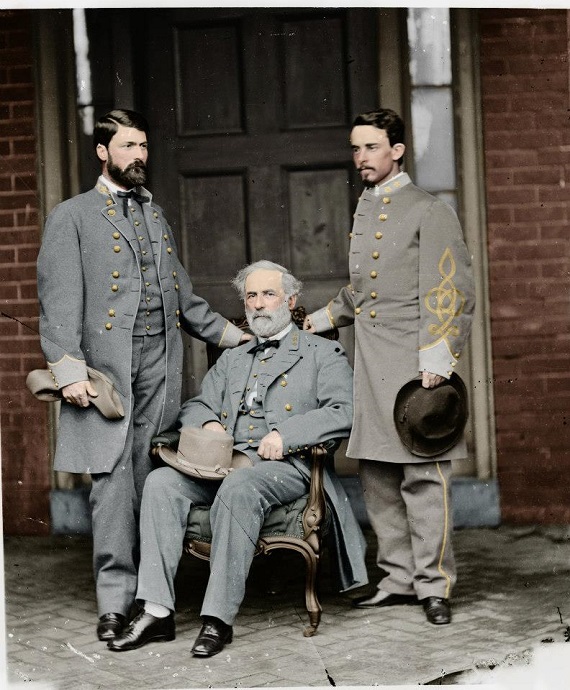
Which is the source of this famous image of his face:
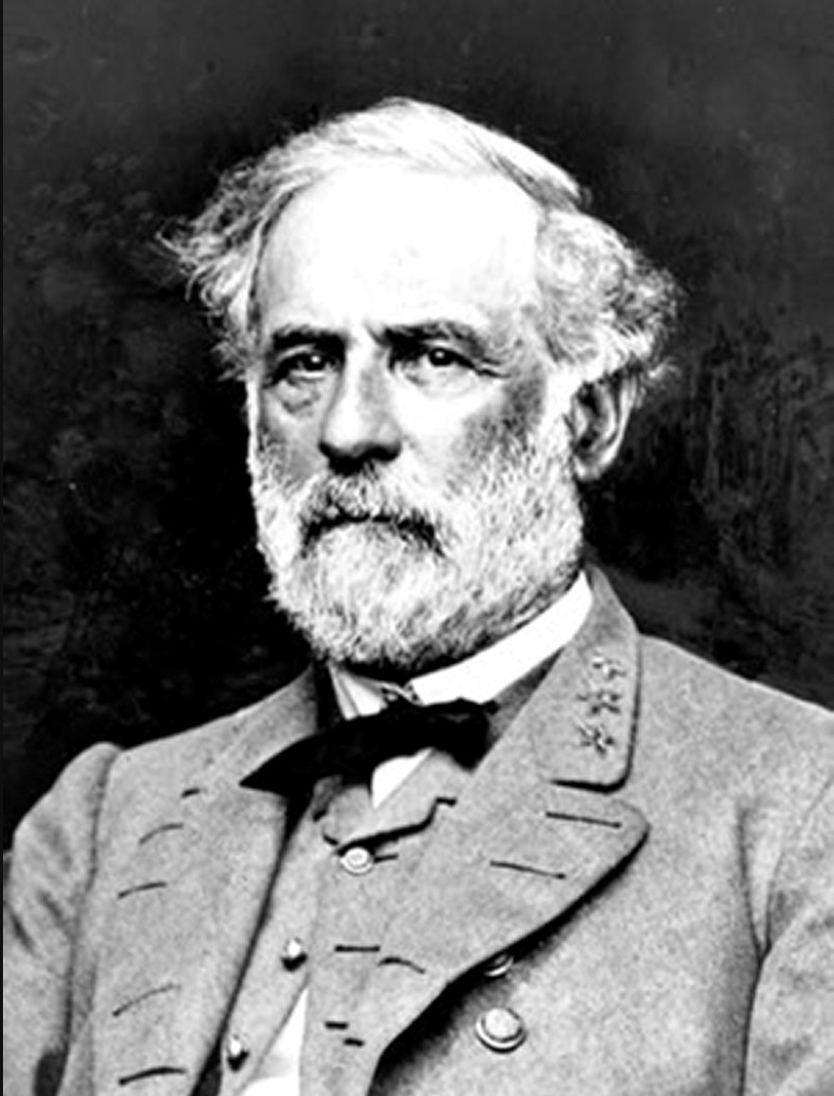
“General Lee with the fire of battle still in his eyes.” That’s how I remember it described in some old book. And indeed, those are not the face and eyes of a defeated man.
Lee’s family came from Shropshire, but he is said to be in the line of Robert the Bruce. He was of a people for whom surrender was an existential horror. As did his men: those amalgam of the West and North of England; the wild Reivers of the Anglo-Scots border; Irish rebels transported by Cromwell or the Crown; the Welsh, the last of old Britain in their mountain fastness; the ferocious Presbyterians of Ulster. What they had in common was a pre-modern, pre-Enlightenment world view.
I would rather die a thousand deaths, Lee said the morning of April 9. And that is perhaps why he sought to charge with the Texas Brigade in the Wilderness, or TK at Spotsylvania: a premonition of doom for his people and his country, an end of all things, a Southern Ragnarok, the world they made and knew and fought for swept away by the rising power, the bearer of the Spirit of an impious age. But if his country was to die, then he lead his men in a last desperate charge, to ruin and death, but they would die like men.
But someone must care for the women and children, he said, And so, like Vercintegorix submitting to Caesar, General Lee surrendered his army to Grant.
Those who knew him saw a new sadness in his eyes. Perhaps, but not in these photographs. It is defiance, an indomitable, unconquered and unconquerable will.
General Lee, in his surrender discussions with Grant, referred to practices in “our army” which differed from those of the army of the United States. The author of Grant’s memoirs frowned at “this implication that we were two countries,” but said nothing.
After reading Grant’s generous terms, Lee looked up with appreciation.
“This will have the best possible effect upon the men,” he said. “It will be gratifying and will do much toward conciliating our people.”
“Our people.” Again, our people.
Finally, in General Order 9, his farewell to the men of his army: “With an increased admiration of your constancy and devotion to your country. . . “
Our people. Our country. Not the “eternal Union” of imperial propaganda, our people, our country, we of the South, the Southern people: ourselves alone.
The old Republic died when General Lee rode from the courthouse, through the soldiers who crowded Traveller, reached for his hand or to touch his uniform. Who fell to the ground sobbing, who swore to General Lee as he rode through the ghost regiments.
Who shouted, as he rode through his shattered regiments: “Farewell, General Lee, and I wish for your sake and mine that every damned Yankee on earth was sunk ten miles in hell.”
Who swore that if General Lee but said the word, they would march and die and charge Hell itself for him and for their nation: baptized with blood and summoned into being at Appomattox.
I wrote here that the war made the Southerners a people: a bond of blood born in carnage and defeat.
But it was, in truth, no defeat. Because at Appomattox, I suggest, General Lee set the spiritual and existential terms of our agreement with those people. We, the Southerners, will remain ourselves: our people, not part of those people and never part of them: not their great mosaic, not their melting pot, not their empire.
And we agreed to comply with their laws, on the condition they kept their bloodstained, grasping fingers far from the monuments we raised to our fallen, and their lying tongues far from our memories. They violated their part of agreement and continue their works of violence against us.
We owe them nothing but contempt. Because now, as their foul kingdom crumbles, the first and only demand on our loyalty and love is the South: the proud land of our fathers, baptized in the blood of our ancestors and called into existence by General Lee. A South of the heart, a South of the soul, and it will endure long past Leviathan’s pre-fab strip malls and sportsball stadiums and brutalist bunkers have crumbled into dust.
Provided, of course, that we remember who we are.
The views expressed at AbbevilleInstitute.org are not necessarily those of the Abbeville Institute.




“We owe them nothing but contempt. Because now, as their foul kingdom crumbles, the first and only demand on our loyalty and love is the South: the proud land of our fathers, baptized in the blood of our ancestors and called into existence by General Lee. A South of the heart, a South of the soul, and it will endure long past Leviathan’s pre-fab strip malls and sportsball stadiums and brutalist bunkers have crumbled into dust.
Provided, of course, that we remember who we are.”
We will never forget who we are. And we can never forget who they are.
A great essay.
Thanks, Mr. Cade, for expressing what many of us still feel today.
A well-written, honest appraisal of the true South yet today, and of the character of the greatest Americans in history, General Robert E. Lee.
This kind of brought tears to my eyes. Great essay.
Same here !
“‘General Lee with the fire of battle in his eyes,’…. And indeed those are not the face and eyes of a defeated man.”
Spot on.
That series of Brady pictures – I favor especially the one of Lee standing alone, hat in hand – are the essence of the man, I believe. I can imagine in his gaze everything he’d seen for the four-plus years, from the double-cross of Northern coercion, accepting that he would be branded traitor, and grief of sacrificing his family’s inheritance, to the heart-rending, horrendous casualties resulting from remarkable victories, and near-misses. Missing from his visage is any sign of contrition.
A modern narrative has developed that RE Lee was torn with regret for his actions. Absurd in itself, I think it likely he had some less than warm feelings and thoughts for elements of the North rarely ascribed to him. He was genuine in his appreciation for Grant’s magnanimity at Appomattox and later insistence in adherence to the terms.
A note: The Gentleman on Lee’s left is not one of his sons. It is Col. Walter H. Taylor, his stalwart adjutant. Serving the entire war with Lee, he was witness to every event of the Army of Northern Virginia. …. except the surrender. Asked by Lee to accompany him to the McLean house, grief-stricken Taylor declined, which he later regretted. If limited to one source for history of Lee’s army, you can’t go wrong with Col. Taylor. Two memoirs and a posthumous collection of letters chronicle, well, the history of the Army of Northern Virginia. Douglas S. Freeman knew him and considered him the final authority.
Major Richard Channing Moore Page, Major artillery, Morris Battalion, Jackson’s Corps, Lee”s army.
My ancestor, was ready to join Mosby. Never surrender, ever