
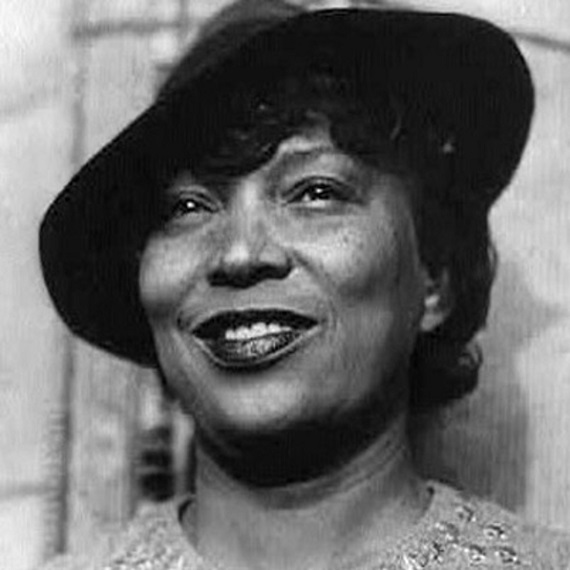
She was the most celebrated Black woman novelist of her generation and died penniless in a Florida welfare home, buried in an unmarked grave. She trained in anthropology at Columbia under Franz Boas and defended voluntary segregation in the pages of the Orlando Sentinel. Zora Neale Hurston spent her life refusing the categories others tried to impose on her.
Hurston was born on January 7, 1891, in Notasulga, Alabama, though she spent her formative years in Eatonville, Florida, one of the first self-governing all-Black municipalities in the United States, incorporated in 1887. Her father, John Hurston, was a Baptist preacher who served as mayor of Eatonville, and all four of her grandparents had been enslaved. Growing up in a self-governing Black community where laws were debated and enacted by Black citizens proved foundational to everything Hurston would later believe. As her biographer Valerie Boyd wrote in Wrapped in Rainbows (2003): “In Eatonville, Zora was never indoctrinated in inferiority, and she could see the evidence of black achievement all around her.”
She described Eatonville as “a city of five lakes, three croquet courts, three hundred brown skins, three hundred good swimmers, plenty guavas, two schools, and no jailhouse.” This experience of Black Southern life as something rich, self-sufficient, and worthy of celebration on its own terms shaped her worldview permanently.
Her mother died in 1904 when Hurston was 13, and her father quickly remarried, creating a rift that pushed her to fend for herself. She worked various jobs, including as a maid for a traveling Gilbert and Sullivan theatrical troupe, before enrolling at Morgan Academy in Baltimore in 1917 to complete her high school studies, and later at Howard University. In 1925, she received a scholarship to Barnard College, becoming its only Black woman enrolled at the time, where she studied anthropology under Franz Boas. While in New York, she became a central figure of the Harlem Renaissance, befriending Langston Hughes, Countee Cullen, and Alain Locke.
This immersion in anthropology and the Harlem literary scene shaped the prolific body of work she would produce over the next three decades. Hurston published four novels, two books of folklore, an autobiography, and dozens of essays over a career spanning more than thirty years. Jonah’s Gourd Vine (1934) was her semi-autobiographical debut novel inspired by her father’s life. Mules and Men (1935) became a landmark anthropological collection of African American folklore from the South.
Their Eyes Were Watching God (1937) remains her masterpiece, a story of a Black Southern woman’s quest for love and selfhood. Tell My Horse (1938) offered an ethnographic study of Voodoo in Haiti and Jamaica. Moses, Man of the Mountain (1939) retold the Exodus story as an allegory of Black liberation. Dust Tracks on a Road (1942) was her controversial autobiography. Seraph on the Suwanee (1948) was her final published novel, set among White Floridians and a deliberate departure from her earlier work. Barracoon, written in 1931 but published posthumously in 2018, documented the testimony of the last known survivor of the transatlantic slave trade.
Despite her enormous output, Hurston never achieved financial security. When she died on January 28, 1960, all her books were out of print and her neighbors in Fort Pierce had to take up a collection for her funeral. She died in the St. Lucie County Welfare Home in Fort Pierce, Florida, and was buried in an unmarked grave until Alice Walker located it in 1973 and commissioned a headstone inscribed “A Genius of the South.”
The revival of interest in her work that followed Walker’s pilgrimage eventually drew scholarly attention back to the political convictions that had cost Hurston so dearly during her lifetime. The cornerstone of Hurston’s political thought was radical individualism. She rejected the notion that races, as collective entities, achieve anything. “The white race did not go into a laboratory and invent incandescent light,” she wrote in Dust Tracks on a Road. “That was Edison.” She applied the same standard to Black achievement: George Washington Carver, not “the Negroes,” discovered the secrets of the peanut.
This set her sharply apart from Harlem Renaissance contemporaries like Langston Hughes, W.E.B. Du Bois, and Richard Wright, who were committed to leftist collective politics of racial uplift — Hughes and Wright as Communist Party fellow traveler and member respectively, Du Bois as a socialist who would formally join the party in 1961. Hurston saw their agenda as exploiting Black culture for political ends. Writing to her patron Charlotte Mason, she explained that “The things our ‘leaders’ are fighting for are privileges for the intellectuals not benefits for the humble.”
In her 1928 essay “How It Feels to Be Colored Me,” she proclaimed that she was “not tragically colored” and rejected what she called “the sobbing school of Negrohood.” She declared that she had received “the richer gift of individualism. When I have been made to suffer or when I have been made happy by others, I have known that individuals were responsible for that, not races.”
Politically, Hurston was a registered Republican and admirer of Booker T. Washington’s philosophy of self-reliance. She backed Senator Robert A. Taft of Ohio, whose vision of liberty she described as standing for the idea that “the people and the individual retain true liberty.”
That commitment to individual liberty extended directly to her opposition to state-enforced segregation. Hurston despised Jim Crow as enforced racial humiliation and called as early as 1945 for “the complete repeal of All Jim Crow Laws in the United States once and for all, and right now.” Yet she drew a sharp distinction between enforced segregation, which she opposed, and voluntary Black self-association, which she celebrated.
On August 11, 1955, more than a year after Brown v. Board of Education, she published a letter to the Orlando Sentinel titled “Court Order Can’t Make Races Mix.” She called the ruling “insulting” and declared that “The whole matter revolves around the self-respect of my people. How much satisfaction can I get from a court order for somebody to associate with me who does not wish me near them?”
Her argument defended Black cultural pride and institutional self-sufficiency. She believed the desegregation drive implicitly framed Black schools and teachers as inherently inferior. The letter itself states the argument plainly: “It is a contradiction in terms to scream race pride and equality while at the same time spurning Negro teachers and self-association.” Henry Louis Gates Jr., who edited a comprehensive collection of her essays, has characterized her position as defending willing separation against enforced segregation.
Her suspicion of top-down remedies extended to the civil rights establishment itself. Hurston was openly skeptical of organized Black political activism. According to Columbia University linguist John McWhorter, writing in City Journal, she “was a contrarian on civil rights activism and she generally lacked interest in being associated with it.” She criticized the NAACP and the Black intellectual establishment, accusing them of using Black cultural expression to advance their own class interests rather than the interests of ordinary Black people.
She reserved particular scorn for Richard Wright. In her April 2, 1938 review of Wright’s Uncle Tom’s Children in the Saturday Review of Literature, she wrote that his solution was “the solution of the [Communist] Party — state responsibility for everything and individual responsibility for nothing, not even feeding one’s self.”
In 1951, she published “Why the Negro Won’t Buy Communism,” arguing that Black Americans had no interest in Soviet-style collectivism because they were aspiring to achieve the middle-class mobility that communism sought to abolish.
This philosophical divide with Wright and the Black left carried over into how she portrayed the region where she came of age. Hurston’s relationship to the South was deeply affectionate, a striking contrast to Northern Black intellectuals of her era. While Richard Wright wrote of the South with dread and fury, Hurston wrote with complexity and scholarly respect.
In her fiction, she situated her novels in the textures of Black Southern life — most famously in the all-Black town of Eatonville — making that life the subject of literary art rather than backdrop for protest. She rejected the expectation that Black writers confine themselves to “the Race Problem,” explaining that her interest lay in “what makes a man or a woman do such-and-so, regardless of his color.”
Her anthropological work, particularly Mules and Men, systematically captured and dignified Southern Black vernacular culture at a time when it was routinely dismissed by White society and embarrassed many upwardly mobile Black intellectuals.
That same respect for Black self-sufficiency fueled her opposition to federal programs she saw as undermining it. Hurston persistently criticized Franklin Roosevelt’s New Deal as paternalistic dependency creation. In her 1951 Saturday Evening Post article “A Negro Voter Sizes Up Taft,” she wrote that “Throughout the New Deal era, the relief program was the biggest weapon ever placed in the hands of those who sought power and votes.” She continued: “Under relief, dependent upon the Government for their daily bread, men gradually relaxed their watchfulness and submitted to the will of the ‘Little White Father,’ more or less.”
Her willingness to assign moral responsibility across racial lines extended into her treatment of 20th century geopolitics. Hurston was a fierce anti-imperialist. Hurston was a fierce anti-imperialist. In a suppressed chapter of Dust Tracks on a Road restored in the 1995 Library of America edition, she denounced Allied hypocrisy during World War II, pointing out that Britain and the Netherlands were extracting colonial wealth from India and Indonesia while demanding moral outrage against Hitler:
“Hitler’s crime is that he is actually doing a thing like that to his own kind.”
She turned her critique toward Roosevelt as well, writing that “President Roosevelt could extend his four freedoms to some people right here in America before he takes it all abroad, and, no doubt, he would do it too, if it would bring the same amount of glory.”
These heterodox positions, spanning domestic policy, foreign affairs, and racial politics, help explain why Hurston resists easy categorization to this day. Hurston remains contested by scholars across the political spectrum. But she is perhaps best understood as someone who, in defiance of the idioms of death and nihilism surrounding her, proclaimed a love of self and a dogged will to live, insisting to the end on what she called “the richer gift of individualism.”