
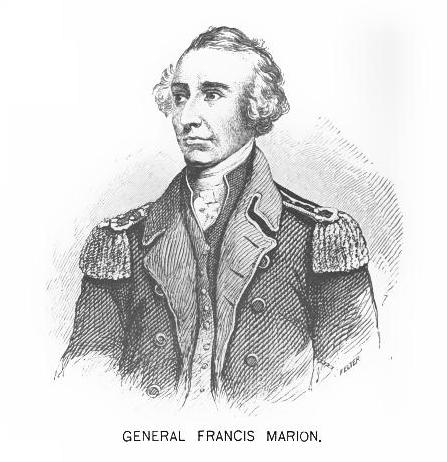
I’m wearing a shirt with Francis Marion displayed proudly on the back. I have portraits of our region and nation’s folklore and heroes hanging on my walls. I have lapel pins of the same. Other shirts have their quotes on them. Without a concerted effort in doing so, I accumulated images and the words of our region’s mythos. I do the same with Christian symbolism. I want to keep the eternal, as well as the legendary, on my mind. From Webster’s dictionary, mythos: a pattern of beliefs expressing often symbolically the characteristic or prevalent attitudes in a group or culture.
Why the symbols inside the house? Well, a natural drift for dedicated followers is to display symbols of what you believe in. An unofficial zeal test perhaps. Or perhaps we want to be immersed in our beliefs through physical symbols for comfort or encouragement, a reminder of who we are and what we think. The symbols and heroes shape our mythos. They embolden our faith.
I traveled to what should become the State of Jefferson (look it up) recently to change scenery. Inside the cabin in those remote mountains was the book ‘American Folklore and Legend’ from Reader’s Digest printed in 1978. The cabin did not have Wi-Fi or cell service – allowing or forcing me to sift through this folklore book. I flipped through the book, stopping to read a tale here and there. What amazed me was how rich in lore our history was even before the Civil War. I tend to overlook the length of our history as colonies and tend to forget how full of lore early America was. The Spanish explorers, Golden Age of Piracy, the immense list of Native American stories, tales to scare kids or inspire them to do better, French stories, English, Dutch, and so on. Many of these tales remind me to do more historical research.
The mythos of the Revolutionary War, Alamo, and Civil War have a prominent place in the book, but those were small parts compared to the vast amount of other tales. They’re all entertaining. The Civil War portion shows the Southern Cavaliers and Yankee generals with objectivity and good story telling. Many other stories I wish I had heard when I was younger. Some were just downright fascinating such as George Washington’s place in Iroquois heaven. Some stories seem so distant now when we know they used to be prominent. It makes me think the 1950s Disney Davy Crockett movies were a sort of final rallying cry to remember our ancient folklore. Even Mike Fink has several tales in this book.
Then something starts to change around the 1880s timeline, after the West was won. The folklore changes tone. Before, the lore was wild, fanciful, often more symbolic than actual. Davy Crockett was a man who could thrive in the wilderness amidst nature trying to harm him, as well as a litany of human foes. The westward pioneers’ tales might be more actual than symbolic with the hardships they overcame, but the real stories were wild. Both cases are inspirational, capture attention, and deepen the mythos of our region and country.
But then near the turn of the century, the tales mostly turn to labor and politics. However, this era’s lore covers many admirable jobs still around today like coal mining, steel factories, railroads, lumberjacks, and so on. But a theme stands out – somewhere our stories all revolve around having to make money. No last stands, no fanciful tales, no frontier, just tales centered around the reality of what we have to do to earn a living.
Of course, the cowboys, riverboat pilots, and fur traders were making money, but they were pioneering in untamed lands at the same time. There were no guardrails or backstops to their hazards. No OSHA, no safety training, no PPE. The world was still wild and unknown. Around 1900, the world was known, and in so doing we no longer explored the same way – we toiled in our labor. And that labor became the modern mythos. Not to say our lore shouldn’t include our economic backbone jobs, but the tone changed greatly.
Then there is another noticeable trend, the pervasive nature of politics in daily life. Union organizing, war effort salesmanship, president this, president that, robber barons, tycoons, etc. And as we know from being alive, this latter nature of our modern mythos is more known.
You see this today in our current mythos with Big Tech and their founders. We can’t escape headlines mentioning a ‘tech leader’ on any day. As if our only frontier is technology. And perhaps, sadly, it might be currently. The boundaries of our nation have been fixed for over 100 years. You can theoretically walk from Savannah to San Diego without a scratch. Even better you can fly there quickly for not a tremendous amount of money. We have 401ks, mortgages, practical jobs, colleges to save for. We have conquered so completely that our mythos, which must always exist whether we like it or not, can only reflect our work and investment interests.
We read all sorts of articles about people being lonely, bored, unfulfilled. Yes. That’s due to the absolute conquering of nature and man. The world is safer compared to 200 years ago. There is no frontier, no wild West, no marauding Comanches, so swindling riverboat captain seeking to press you into his crew after a raucous night out in the bar. The world is known, predictable, and sustenance is nearly guaranteed if you stay employed. Our modern mythos reflects this – which is why we are uninspired and bored. Our mythos of old reflected our optimism and opportunity in the unconquered world.
Mythos reflects our sentiment at any given point in time. For example, post World War 2 America has great zeal for our heroes of that war. Thos who served in the US military know most of the unit history tends to begin with World War 2 – even if their unit history begins much earlier (Teufel Hunden excluded). It was such an impactful moment in time that most Americans truly divide world history as before World War 2 and after.
There are many reasons for this. Many Americans, despite having lengthy genealogy in the country, side with their latest immigrant demographic – looking at you Boston [Irish] and New York [Italian]. The immigration waves before World War 2 were enormous, therefore that is the origin lore for many families in America. Origin stories are fundamental to all group identities. And many veterans form their military history basis around unit history – as well as growing up all sorts of media focused heavily on World War 2. Finally, but not completely, our parents, grandparents, or great grandparents were in that war and we knew them personally. All these reasons are understandable as to why the modern American mythos holds World War 2 and modern tech as our modern origin story and current lore respectively.
I do genealogical research for friends. Almost invariably when it comes to veteran family history they immediately ask for info on their grandfathers in World War 2, which I still find honorable and rewarding. However, when I show them Civil War regimental history there is a long pause before the conversation continues. Kind of like they’re saying, ‘oh yeah, forgot about that’. To be fair, most people do not know their family history before World War 2, and do not know the tools to find this history.
Now moving forward, you must ask yourself: what do you want to propagate to your children, countrymen, and posterity? What mythos do we want to instill as our lore? What do we really hold as our origin? Whatever mythos we subscribe to reveals our loyalty and identity. Whoever you hold as your heroes will reveal what you believe. Choosing our mythos, whether organically or not, is critical to shaping our society.
For example, the concept of America as a ‘melting pot’ is a mythos that is just over 100 years old and was an influenced mythos. ‘The people’ didn’t coin the term, an individual did – and the press took off with it. It was a mythos that didn’t necessarily do anything. It wasn’t a frontier to explore or hazard to overcome. It was something passive that happened to the country. Again, the post 1900 mythos largely becomes more actual and less aspirational.
I contend it’s time to move on from the 1900-1945 lore. It’s time to make 1607 our origin story, as previous writers for Abbeville have belabored. The modern big tech and pervasivepolitics mythos could also use a break. We need more emphasis of mythos not centered on labor, tech hype, presidents, and civilizational suicide. The World War 2 mythos will always remain as part of our country, but we need to shift. Having the ‘modern world’, for those who think like this, beginning out of the bloodiest war in human history is inherently negative and likely damaging to our psyche. Not that the war needs to be diminished, but any concept of our people ‘beginning’ in the 1940s is absurd. Minds must be expanded, horizons broadened, more history learned.
Let me highlight a great explanation of what mythos used to be and must become again. Kaiser Von Lohengramm is a phenomenal account on X to follow for posts regarding mythos, and what I’m driving at here. He posted earlier this month about Francis Marion and what Marion means to our mythos – the timing of the post coinciding with my revelatory Reader’s Digest find. Kaiser writes,
I’m reading an antebellum era book called The Life of Francis Marion by W. Gilmore Simms to learn a bit more about one of the greatest partisan fighters ever to be born, certainly one of the best in America. And the way that this history is recorded, particularly what is in the introduction, strikes me heavily. The author writes of how the history of the Southern theatre of the Revolutionary War has been badly kept in the records saying in particular of Marion,
“It is a people’s history, written in their hearts, rather than in their books; which their books could not write—which would lose all its golden glow, if subjected to the cold details of the phlegmatic chronicles. The tradition, however swelling, still testifies to that large merit which must have been its basis, by reason of which the name of the hero was selected from all others for such peculiar honors; and though these exaggerations suggest a thousand difficulties in the way of sober history, they yet serve to increase the desire, as well as the necessity, for some such performance.”
I don’t care for phlegmatic chronicles. I think they are in and of themselves a flaw of modernity. And with Simms, though he is writing history here, was a novelist first and foremost, and his telling of Francis Marion reads more like fiction than a dry history. So, give me the golden glow and the mythos, the story crafting and telling. There is a deeper truth in this, a human quality that is far more valuable than this supremacy of a “cold hard truth” above all else. Ancients understood this well, its why you get things like the Homeric works and The Aeneid.
Deep truths and what is valuable to man are often best communicated through narratives, myths, and fiction in ways which transcend some pure pursuit of fact and truth stripped of all else, which is a deeply modern thing that just deadens life itself and misses the forest for the trees.
Well said. The mythos overpowers the actual. The mythos drives our mentality. We can choose our mentality by choosing what we keep as our lore. This is different than ‘where your heart is there will be your treasure’. Mythos outside of Christianity is for the corporal world, for our society’s earthly mental health so to speak.
All this to be said, if you do not have a comprehensive or cogent mythos in your own life, let alone as a society, you are susceptible to being influenced into having one given to you that you otherwise wouldn’t choose. Do not let society choose a mythos for you or your children. Look at our region’s legendary men: Washington, Jefferson, Lee(s), Crockett, Boone (honorary), Marion, and countless more. Just listing a few names feels like an injustice to the vast number of legends that have existed in the South – let alone the rest of the founding colonies since 1607. I emphasize the South here because another observation in the folklore book is how many of our colonial and national mythos figures are from or the stories take place in the South, then later the West. You can even seek mythos beyond our region and country into the heroes of Christendom before 1607, but that’s for another day.
I’ll close with a caveat. And that is if you choose a modern person alive today to form your mythos, as many legends were and are alive during their fame, be very careful. The conclusion of their story might be negative, and a lot of time and effort will be wasted. Imagine if Crockett fled at the Alamo. Given our ahistoric society today, I contend we reacquaint our mythos to incorporate more legends from 1607-1880 to balance our overweighted modern lore.
The views expressed at AbbevilleInstitute.org are not necessarily those of the Abbeville Institute.