

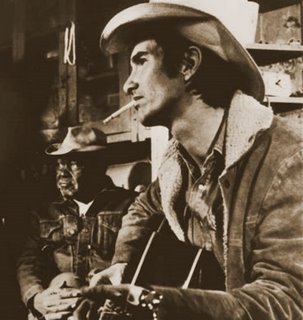
Townes Van Zandt was an American singer-songwriter born in 1944 in Fort Worth, Texas, whose work occupies a quiet but enduring place in Southern music. His songs sit at the crossroads of folk, country, and blues without ever settling comfortably into any of them, largely because he showed little interest in belonging to pre-set categories. Born of Dutch ancestry and raised in a well-to-do family, Van Zandt gravitated toward music in his early adulthood. He released his first album in 1968 and spent the next three decades largely on the road, performing in clubs, coffeehouses, and small listening rooms across the United States and Europe.
From the beginning, Van Zandt’s work stood apart from both the polished Nashville sound and the politically charged folk revival of the late 1960s. His career developed slowly and unevenly, built less on commercial momentum than on persistence. While his albums were respected by musicians and critics, widespread success eluded him during his lifetime. What endured instead was his powerful reputation among other songwriters, many of whom recorded his work and quietly absorbed its lessons. He wrote his own songs almost without exception, and his legacy rests squarely on that authorship rather than on performance spectacle or stylistic innovation. Although many songwriters might compose in the Townes Van Zandt style, no one plays guitar in the Townes Van Zandt style, because there’s not one.
Van Zandt’s songwriting is defined by spare construction, narrative restraint, and emotional precision. His songs frequently focus on loneliness, displacement, love that fails quietly, and people who seem already aware of their own limitations. Musically, he favored simple chord structures, finger-picked or lightly strummed acoustic guitar, and melodies that closely followed the natural contours of spoken language. His Texas accent was never concealed, giving his performances a sense of regional specificity even when the songs avoided explicit geography. He did not turn his Southern identity into a performance-based affectation, but allowed it to be familiar, as though the songs were spoken rather than presented.
Politically, Townes Van Zandt is best understood as apolitical. He did not write protest songs, align himself with movements, or use his music to argue for ideological positions. Unlike contemporaries such as Bob Dylan or Phil Ochs, he showed little interest in topical commentary or public argument. When social conditions appear in his songs, they do so as background circumstances rather than subjects for critique to prove a point. His portrayals of poverty, addiction, and isolation are descriptive rather than advocative. Van Zandt never instructs the listener on what should change or who is to blame, and any political meaning drawn from the songs arises from listener interpretation, not from the songwriter’s intent.
For listeners unfamiliar with Townes Van Zandt, it is helpful to think of his music in terms of consistency, and allow his work to reveal itself gradually through repeated exposure rather than dramatic variety. Songs such as “If I Needed You” introduce his accessible side without misrepresentation. The melody is gentle, the structure straightforward, and the lyric communicates affection without sentimentality. “Pancho and Lefty” demonstrates his amazing narrative economy, telling a mythic story without theatrical emphasis or moral resolution. “Marie” offers a stark portrait of hardship delivered with emotional distance rather than self-dramatization, while “Tecumseh Valley” shows his ability to tell tragic stories without exaggeration or judgment. “To Live Is to Fly” captures his philosophical side in language that remains grounded and conversational, and “Waiting Around to Die” stands as one of his most direct examinations of endurance.
A defining feature of Van Zandt’s music is its relaxed posture. In “If I Needed You,” the tempo sits just below conversational pace, creating a sense of ease. The guitar rocks gently, the melody unfolds unhurriedly, and nothing in the performance pushes for attention. This kind of relaxation resembles the experience of sitting on a front porch on a warm evening, with time loosened just enough to allow listening to feel effortless.
His sense of groove operates similarly, and in “White Freight Liner Blues,” the rhythm is driven by a loose shuffle feel rather than strict subdivision. The tempo is brisk, but the phrasing leans forward and pulls back in small increments, creating motion without too much tension. The guitar and vocal don’t align rigidly with the beat, which reflects a Southern rhythmic tradition where feel outweighs precision.
The concept of “Home” is another central concern in Townes Van Zandt’s work, though it is rarely treated as destination or inheritance. His songs do not idealize land or tradition, and fields, valleys, rivers, and skies appear as lived environments rather than symbols. In “Tecumseh Valley,” the setting is what shapes the story. Churches appear as social facts rather than theological centers, and domestic spaces are presented without nostalgia. In “Marie,” references to shelter and sustenance emphasize scarcity. In Van Zandt’s world, “Home” is transitory, provisional, and often inadequate.
One of Van Zandt’s more unusual musical traits was how unperformative he was during performance. He showed little interest in audience management, emotional pacing, or dynamic shaping designed to recapture attention. As a result, his live performances were sometimes unpredictable and uncomfortable, but the songs themselves retained their original proportions. They were not scaled up to fit larger rooms or expectations, which helps explain why his live and recorded versions often feel closely aligned. He also possessed a dry, sometimes abrasive sense of humor that complicates the common image of him as relentlessly bleak. His jokes and asides were delivered without setup and often landed sideways, mirroring the tonal ambiguity of his songwriting. Darkness and humor existed side by side.
Stylistically, Townes Van Zandt’s songwriting changed very little over time. His early songs already contained most of the elements that define his mature work, and later recordings show refinement rather than expansion. This consistency suggests an artistic identity arrived at early and maintained with discipline throughout his career, an unusual stability in a life marked by personal instability and constant travel.
Townes Van Zandt died in 1997 at the age of fifty-two from complications related to long-term alcoholism. What remains active is his catalog, which continues to be recorded, studied, and performed by musicians across genres. Although there has never really been a celebratory revival or rediscovery of his music, his reputation grew steadily after his death. His songs endure because they function at small scale and hold up when placed in new voices.
A striking measure of Townes Van Zandt’s stature is not chart performance during his lifetime, but the caliber and persistence of artists who have chosen to record his songs, which were not casual tributes. In many cases, the covers became central to the covering artist’s own catalog, which tells something significant about the durability and transferability of his writing.
Among the most prominent interpreters is Willie Nelson, whose duet version of “Pancho and Lefty” with Merle Haggard brought the song to a mass audience in the 1980s. That recording is often mistaken as the song’s origin point, which says less about Willie and Merle than it does about how seamlessly Townes’s writing can inhabit other voices without losing identity. Emmylou Harris also recorded a notable interpretation of “Pancho and Lefty” in 1977, several years before the Willie Nelson–Merle Haggard duet brought the song to a mass audience. In addition, she recorded “If I Needed You,” turning it into one of the most widely recognized entries in the Townes catalog. Her bare version highlights the song’s structural strength, demonstrating how little rearrangement is required for the song to function across stylistic contexts. The melody and lyric carry themselves. Steve Earle has been one of Townes’s most vocal advocates, recording multiple songs including “Pancho and Lefty” and “If I Needed You,” as well, and frequently performing his work live.
In a more unexpected vein, Robert Plant of Led Zeppelin recorded “Nothin’,” demonstrating how Townes’s writing can migrate into rock contexts easily without strain. Similarly, Norah Jones recorded “Be Here to Love Me,” a song that reveals how Townes’s understated melodic sense translates into contemporary singer-songwriter idioms. Guy Clark, a close friend and peer, recorded several Townes songs and helped preserve his work within the Texas songwriting tradition.
Other notable artists who have recorded significant Townes Van Zandt covers include Lyle Lovett, Calexico, Lucinda Williams, and Cowboy Junkies. The breadth of this list—spanning traditional country, Americana, rock, and alternative folk—underscores a key fact about Townes Van Zandt’s songwriting: it is specific enough to remain identifiable, yet open enough to survive translation.
Taken together, these recordings show that Townes Van Zandt’s influence has operated less through imitation than through adoption. His songs continue to circulate not because they demand preservation, but because musicians keep finding them usable, speakable, and structurally sound in their own voices.
Taken as a whole, Townes Van Zandt stands as a great Southern artist not because he represents the South loudly or symbolically, but because his music is shaped so remarkably by a simple Southern way of speaking, listening, and enduring. His songs remain grounded in lived conditions rather than ideals, and his sense of place is defined by familiarity. By honoring those realities, he created a body of work that continues to speak clearly to listeners willing to sit with it and listen.
The views expressed at AbbevilleInstitute.org are not necessarily those of the Abbeville Institute.





GLAD TO BE BACK ON YOUR WONDERFUL. EMAILS!!!!
Thanks for this very interesting discussion of Van Zandt, someone I discovered belatedly… intrigued by how so many songwriters revere him. Pancho & Lefty, Tecumseh Valley (preferably as a simple duet like Jake Hill & Allyson Harple–Nancy Grifith’s voice is annoying after a bit), and None but the Rain are my favorites.
Thanks for this very interesting discussion of Van Zandt, someone I discovered belatedly… intrigued by how so many songwriters revere him. Pancho & Lefty, Tecumseh Valley (preferably as a simple duet like Jake Hill & Allyson Harple–Nancy Grifith’s voice is annoying after a bit), and None but the Rain are my favorites.
Watch his Heartworn Highways on the u tube…sad to see lack of discipline ruin such a talent.
The girl invented torn blue jeans…pay her royalties…
I had not heard of Townes, until the television series “True Detective” first season appeared. Now I can’t get enough of his music.